Plaguebearers

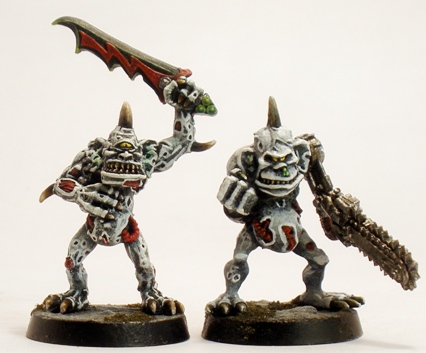
Some of my old 40k stuff today.  Plaguebearer Nurgle daemons.
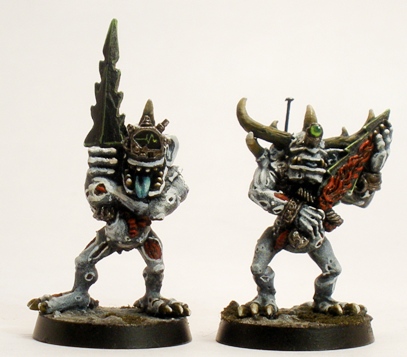
Plaguebearers are Nurgles tallymen, embodying the futility of mortal existence by constantly making lists and categorising myriad life matters which cannot be measured.  Just like me.
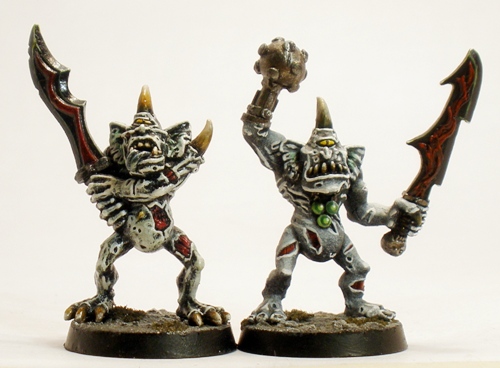
Plaguebearers all bear the signs of rot and decay in addition to monocular vision and a horn (occasionally more than one).  Usually they are portrayed in brownish greens, like everything Nurgle tends to be.  I broke from the norm and chose to tie my plaguebearers colour scheme to my Sin Eaters marines.
In that era 40k daemons were summoned into play, popping into existence when certain game criteria are reached (its probably done similarly in current 40k, but I dont know for sure).

In an effort to make my figures unique and to tie them into sci-fi rather than fantasy Warhammer I added cybernetic elements to a number of the figures.

Conceptually I see those as bits of junk that coalesce into usable forms along with the daemon itself (being unliving embodiments of decay and all that).  If you imagine Tetsuo fusing with surrounding mechanical objects towards the end of Akira then you are on the right track.

Mainly I did it because I thought that it would be a fun project to make some goofy demon figures into cyborgs, ’cause I like cyborgs more than demons.

The figures are a mix of six of the original plaguebearers from the eighties, plus four of the nineties guys.  It is easy enough to tell which are which I think.

The cyborg weapon elements are all Necromunda Pit Slave parts, plus an old Warlord titan chainfist.
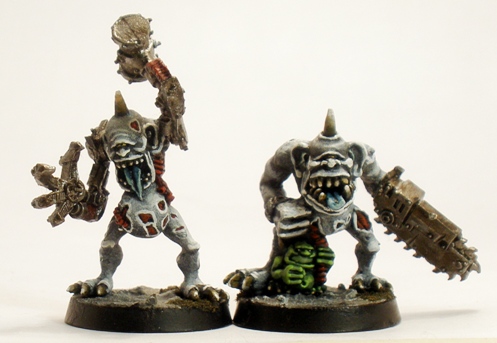
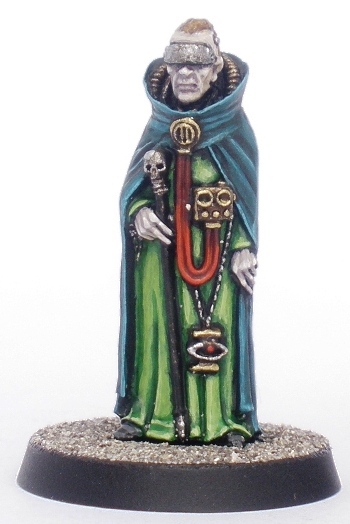
My favourite pair of these goofy freaks are shown in the first and final photo.  One guy has had his eye replaced with the screen from an Imperial auspex, complete with EEG style readout.  He also had a piece from a radar dish glued to his back.

The other guy has a rifle sight in place of his eye.  He also has a backpack with an aerial and a Nurgle symbol on it.  Far out.
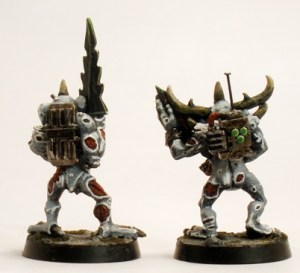
 

The paint job is quite cartoony, aided and abetted by the comical sculpts and ludicrous bionics.  I like the look, even though they might jar a little with some more “serious” looking 40k figures (although at the time of writing Space Wolves mounted on wolves from space have just been released and even they are not as silly looking as the preposterously poorly conceived Dreadknight).

The plaguebearers have featured in very few games.  I once used them in a day long mini campaign and then in casual home games a couple of times.  They were always lacklustre in rules terms in those days.

I plan to use them for some skirmish games using Inquisitorial retinues and the like at some stage, hopefully during the next couple of years.  I might have them lead by Judge Mortis some time too: I can see Dredd Hi-Ex-ing a few of these guys.

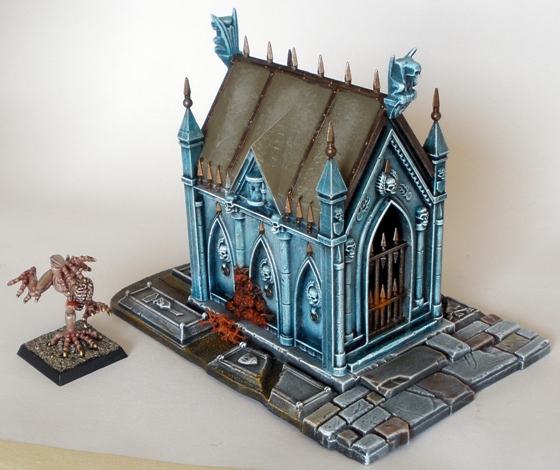
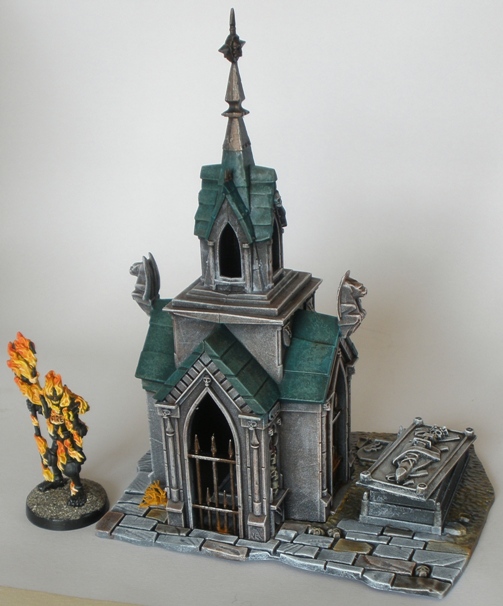
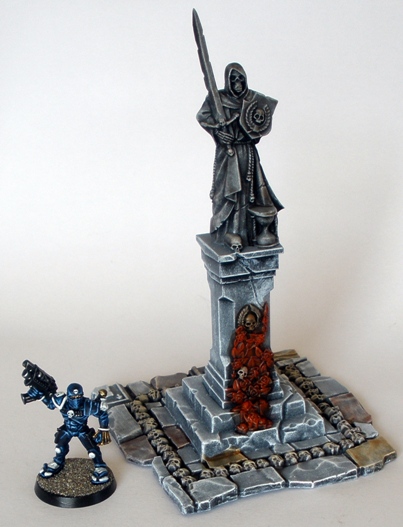
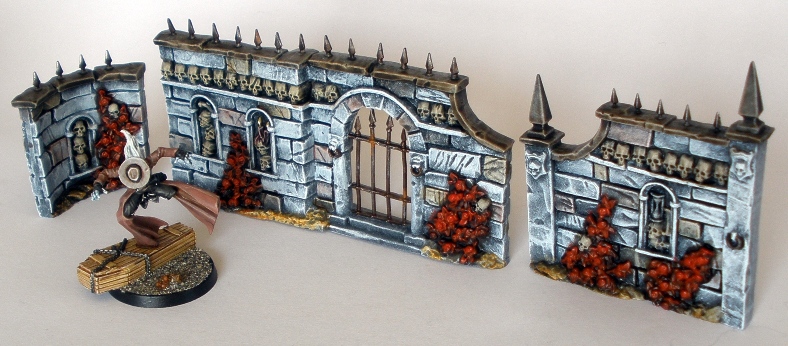
St. Craniums Cemetery

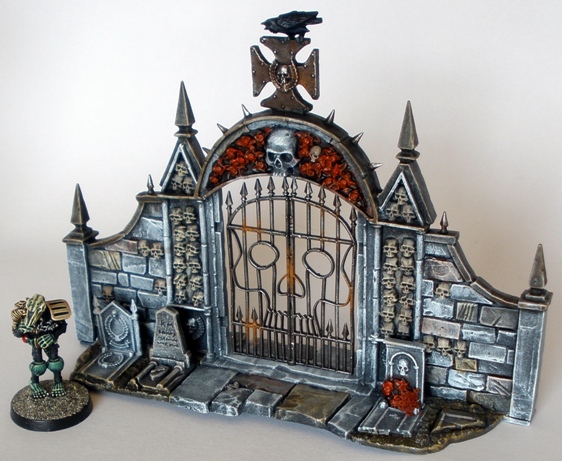
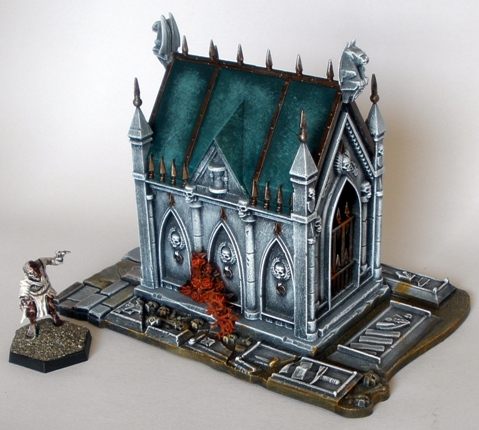
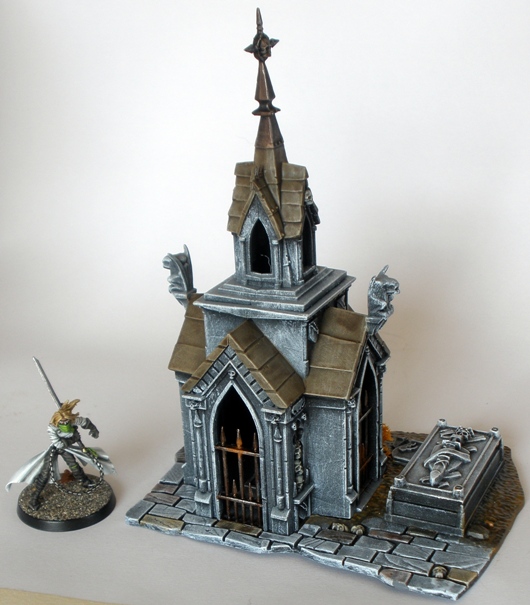
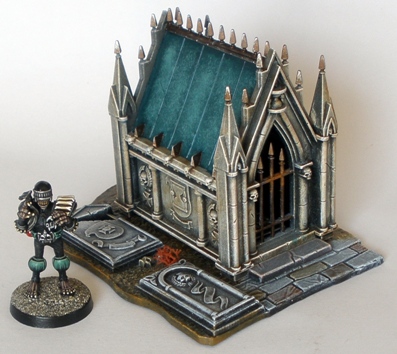
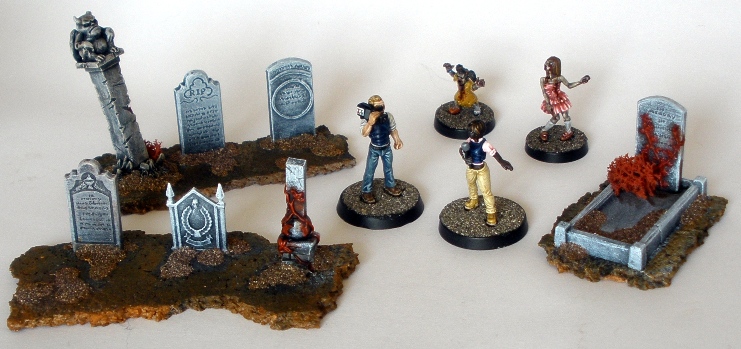
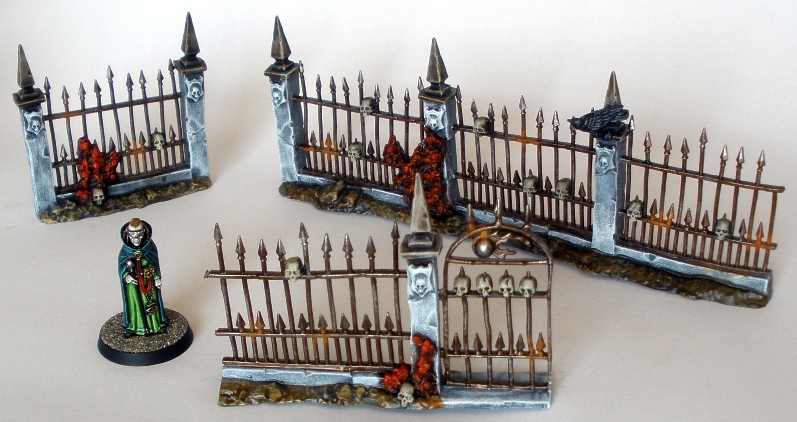
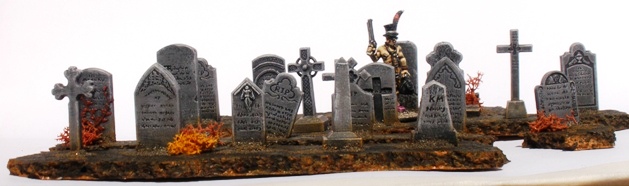
Following on from Mondays WiP post here are some close up shots of some of the finished graveyard elements.

A few meandering points:

  1. I wanted to avoid green plants.  Therefore I went with rusty red on the undergrowth to get the terrain to fit in with the rest of my wastelands stuff which in turn matches the bits of lichen that I attached here and there.
  2. I am particularly pleased with how the mausoleum roofs worked out.  I am also happy with the three crows that feature throughout the piece.   By using a different technique to the last time that I tried to paint black birds they came out much better.  Its a very minor thing, but satisfying for me.  Sometimes it really is the little things.
  3. The large skull-faced gates (one of two shown) are both magnetised so they can be removed as and when required for game purposes.  I considered leaving the gates permanently open, but adding the magnets was more fun.
  4. I went for a walk around a local overgrown graveyard and took some photos in preparation for painting this stuff.  As It happened I simply went for the easy, more theatrical approach to painting the pieces rather than trying to duplicate complicated patterns of wear and plant growth on the pieces.  The end result is more Scooby Doo than some might like.  Visiting the old graveyard turned out to be interesting in itself anyway, even if it had little influence on how the models finally turned out.


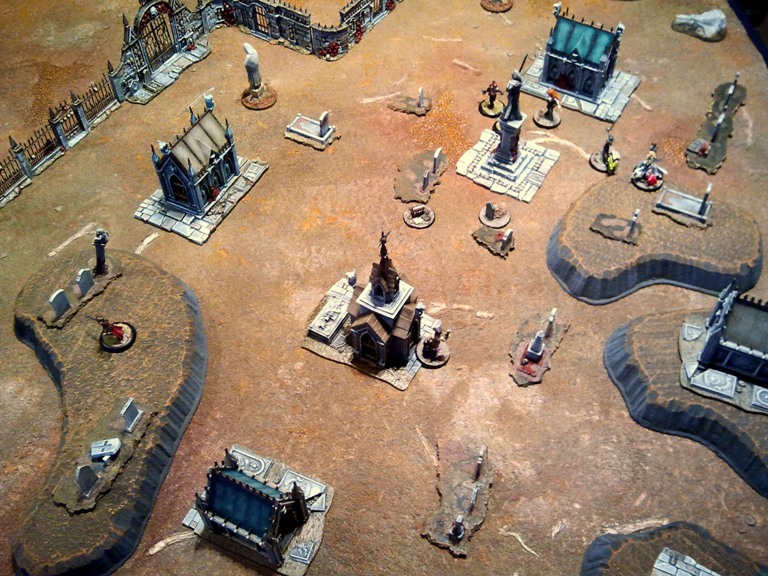
Since I finished these I have dug up a few more bits that will be getting painted up to go with this set, but for now I have plenty to game with.  In fact I played a game with COM on the brand new graveyard terrain within hours of finishing it, which was satisfying.

Graveyard WiP

I have wanted a graveyard terrain set to game with for many years, but I never got around to picking up the many expensive crypt, mausoleum, gravestone and perimeter pieces required.

Then Games Workshop released the Garden of Morr graveyard kit last year.  It looked like a convenient and reasonably cost effective way to cover my toy soldier graveyard needs so I picked up a couple of sets last Autumn.

After some consideration I decided that I would prep the graveyard to fit with my wasteland terrain.  The classic movie graveyard tends to be a bit greener than that and for a while I was tempted to go for that more Transylvanian look.  I have a bit of an aversion to playing games on green, golf course like tables however and as I had already painted up some Renedra gravestones that I picked up at Salute last year to match the wasteland terrain, I went with that again here.

The Renedra gravestone kit is straightforward and very nice.  The Garden of Morr is fantastic.  It goes together very easily without need for clamps or rubber bands or anything fiddly.  It also looks really nice when assembled, even before painting.

The painting process took me a few hours each day for about four days or so. I tend to be slow at things like this so its possible that some time could be shaved off that I reckon.  Below are the steps that I used to prep the lot, which should give anyone interested an insight into how I approach projects like this, for better or for worse:

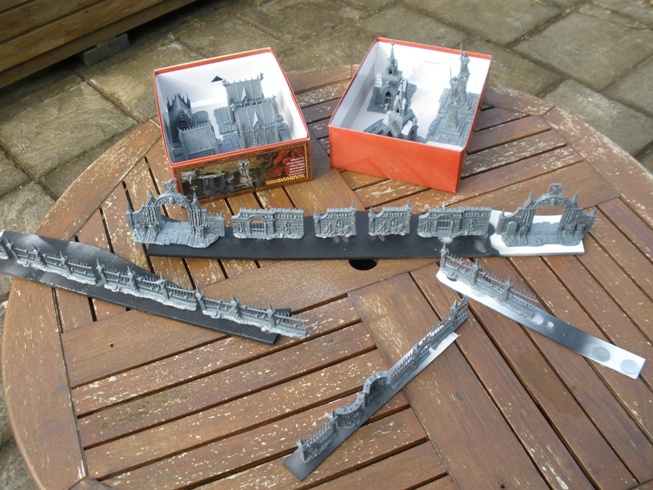
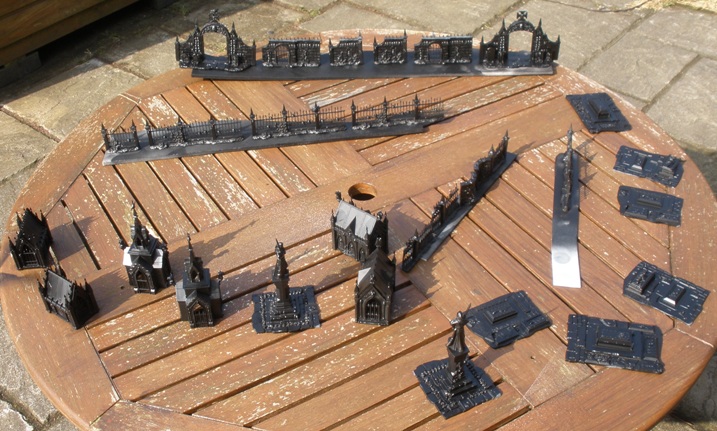
Parts were clipped from the frames, mould lines and the like were cleaned off and the loose gravestones were attached to cork tile bases.

Everything was sprayed with matt black acrylic car paint.

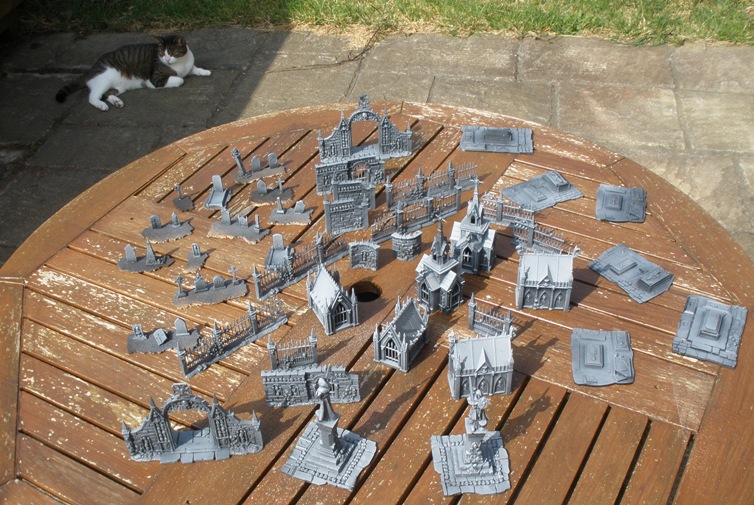
Next all of the pieces were lightly sprayed with grey primer spray from above.  I recently read somewhere that the kids call that “zenith highlighting”.  Who knew?  Cat provides cheerleading section.

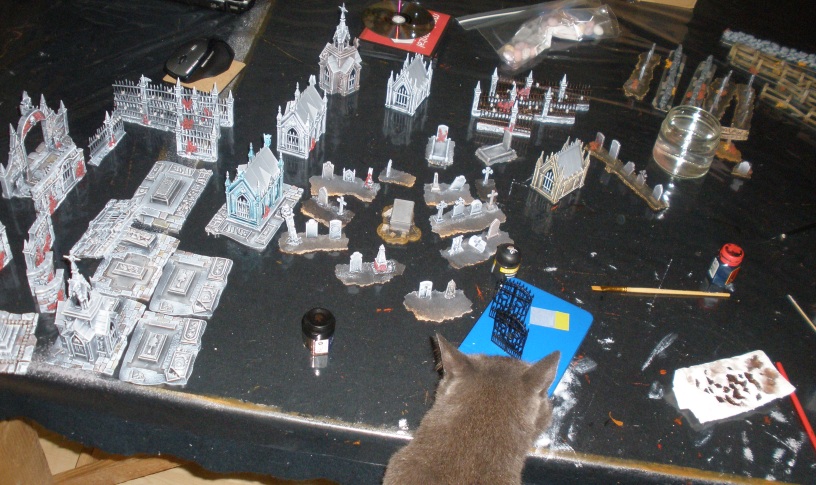
All of the parts were then given a pretty heavy drybrush of white acrylic.  Note the Deadwood DVDs that were running on the laptop while I worked, helping to keep me in a cowboy frame of mind.

Some areas were tinted with washes of ink and/or thinned paint.  Detailing started in some areas.  Another cat provides aesthetic critique.  Note the DVD rental of Cowboys and Aliens which I had hoped would keep me in a Western frame of mind.   It didnt.  Dont watch it, its depressingly awful.  If I believed in souls then “soulless” would be an apt description.

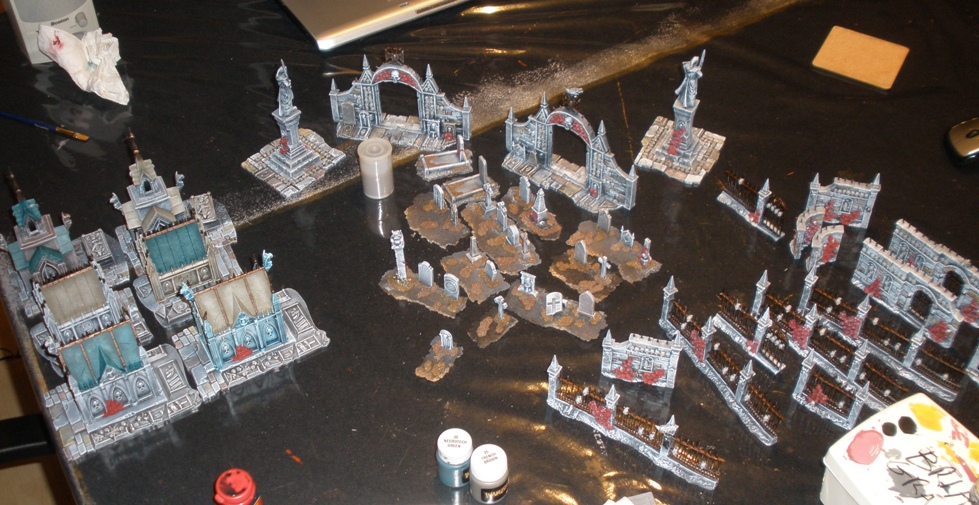
More detailing. The most significant progress here was on the mausoleum roofs, although various other elements were also layered up.  This was usually done with a single tinted translucent colour so that the black through grey through white beneath showed through.  Painting GW Tin Bitz on the railings was the most tedious part of the whole job.

I am not really a GW basher: I have had plenty of fun with their products over the years even if I dont tend to have a whole lot of interest these days.  But there was a somewhat amusing element to this kit that I thought that I would mention.

GW products get a lot of stick about their propensity to stick skulls and skull motifs on any vaguely flat surface.   A graveyard seems to me to be one of the few places where its possible to get away with that sort of thing, but the GW designers decided to go berserk with skulls on the Morr kit.

Out of (morbid) curiosity I counted the skulls and skull motifs on the set.

A Garden of Morr features:

  • 244 “human” skulls
  • 115 skull motifs
  • Total 359 skulls per kit

I assembled two kits meaning that I quickly painted a staggering 718 skulls.  Hilarious.

A few skulls here and there is fine with me as I am not going for a realistic looking, architectural style piece.  The sort of graveyard that featured in Buffy or Scooby Doo is what I was looking for.  Even so, that really a lot of skulls.

If the vast amounts of head bone on the kit dont bother you then I thoroughly recommend it, its very practical in game terms and it assembles very quickly and easily.  I would not recommend buying the kit with the intention of removing most of the skulls and skull motifs as it would be a huge pain in the arse.  I am sure that some people would do it, but it would feel like a waste of time to me.

Photos of the finished elements of St Craniums Cemetery will be posted up on Wednesday.

Mali-photos

I have been playing Malifaux since mid-February.  In that month or so (at the time of writing) time I have got seven or so games played, which is an awful lot by my standards.

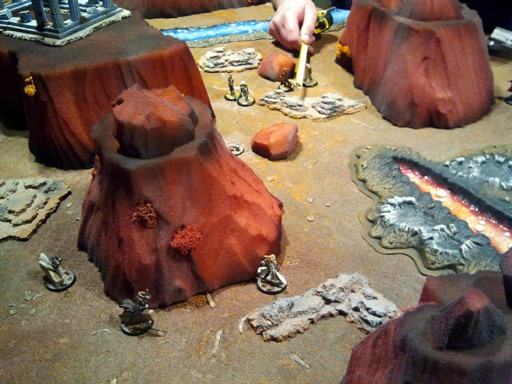
The majority of the games have been at home, although I got an opportunity to play in another gamers house too (the games played on the green table shown below).

One of the things that I have enjoyed most about the process is digging around in the boxes of terrain that I own in an effort to make each game table coherent and unique.

After the effort that I have put in over the last couple of years I now have a lot of terrain, most of it practical and of pretty decent quality: I am happy to say that it is largely better than the majority of the terrain that I have seen in actual use (actual use rather than set pieces for shows or spectacular set ups for rulebook photos) over the years.  Its far from award winning stuff but its solid, practical and is supplied in volume.  Malifaux is finally bringing a lot of that stuff to the table for actual use, which is very satisfying.

I have been taking photos at various points during each game.  A selection of these quick snaps are shown below, just for fun really.  Lady Justice features a lot, seeing as she is the leader of my first completed Malifaux crew.

Lady J considers a game of Pooh-sticks swords during an away game.

The Judge leads his Death Marshals through the hazard strewn Badlands.

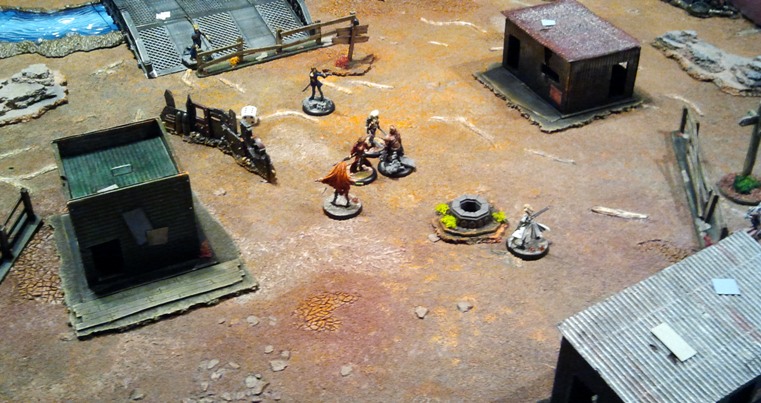
The Viktorias take on the Guild in an abandoned shanty town.

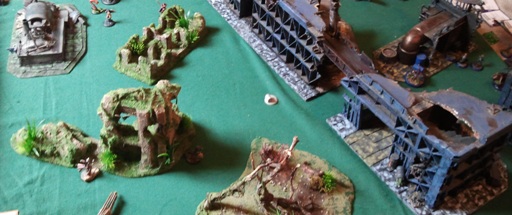
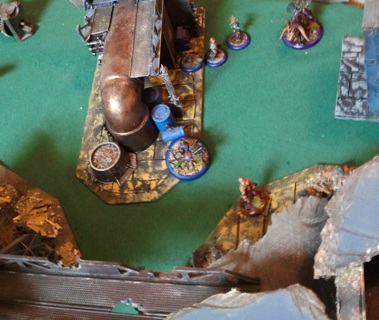
A ruined industrial zone is the stage for a three-way battle between Neverborn, Arcanist and Guild forces.

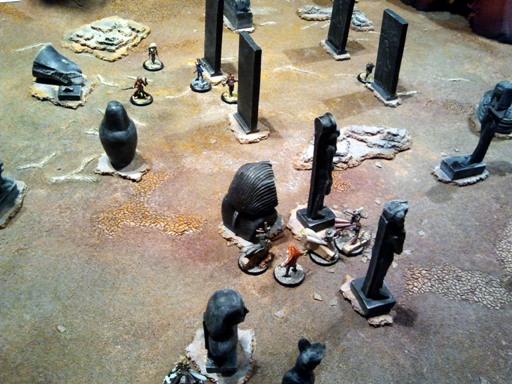
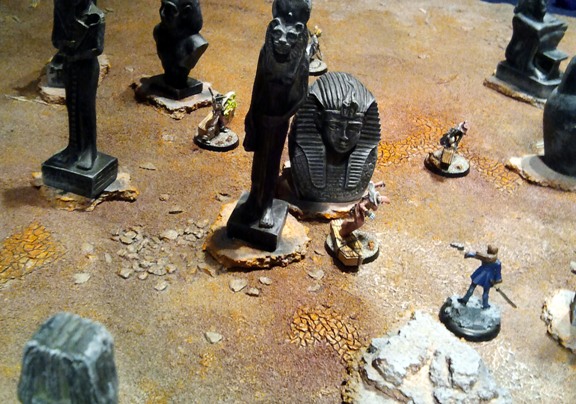
Ancient statues provide cover against flying lead.

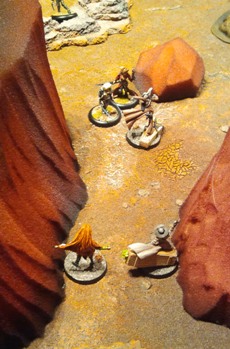
Cowboy exorcists collide with twin psychic samurai ladies in a badlands canyon.

Ramos conjures up arachnid robots in the ruins of a factory.

Death Marshals attempt to encircle a Ronin.

I have some more terrain in the pipeline.  A few more post apocalyptic shanty type bits and pieces will be first in all likelyhood.

I also have plans for some cow town stuff, but it will need a little bit of wiki-wiki-wah-wah west-ifying before I will be happy with it.  I want it to look like something suitable for a Firefly/Malifaux setting as well as suitable for the Cursed Earth and the occasional frontier planet for 40k folk to show up on.  We will see how that goes.

Malifaux: Objectives

Malifaux play is geared around “Schemes” and “Strategies”.  While there are a small number of these that are based on simply battering the opponents forces, most involve holding areas or moving certain items.  These objectives are represented in game by 30mm diameter bases.

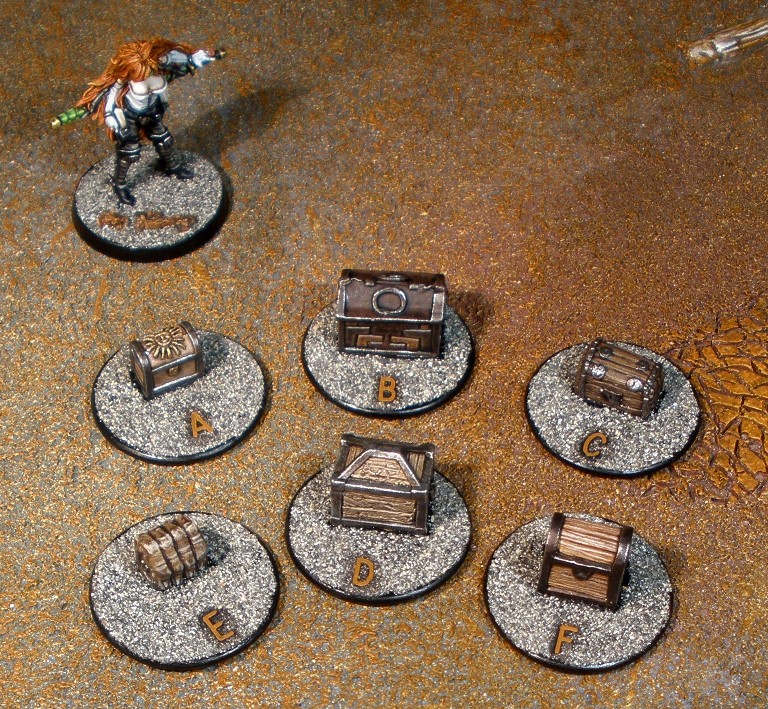
The treasure chests above were purchased in Games Workshop, Oxford St, London way back in 1989.  I originally bought the pack of ten (or perhaps two packs of five, I cant remember) for use in Dungeonbowl, a Blood Bowl variant which was… wait for it… played in a dungeon.  The chests languished in the lead pile ever since, only to finally be given some love this year, a terrifyingly distant twenty-three years later.

I added the letters in case I will at some later stage need to randomise the chests for whatever reason.  A brilliant and much more aesthetically pleasing way to achieve this (that I was too lazy to copy) was done on Phreedhs Miniature Stuff a while back.  Unfortunately I cant currently find that particular post on the newly organised blog (Mattias, if you see this then put a link in the comments if you would like to show off your lovely work).  EDIT: that link is HERE.

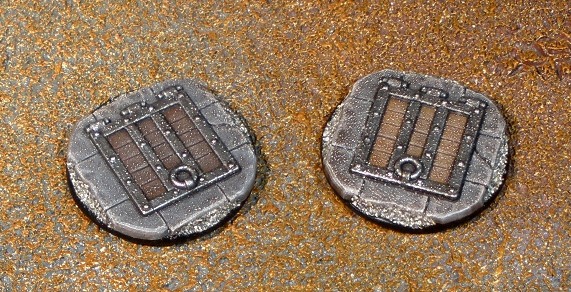
The next objectives are trapdoors that were supplied with some GW LotR stuff.  PB gave me a lot of the accessories from those sets as he knew that it was unlikely that he would ever get around to painting them and that I likely would.  It looks like he was at least half right.  Ta-da!

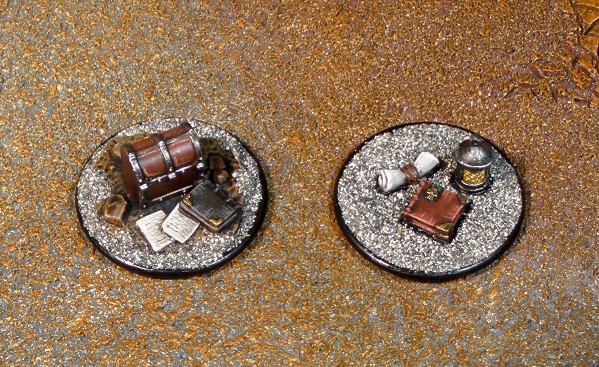
The two above are my favourites.  I think that they both suggest a little story and playing miniature games is all about story.

The left hand one is supplied as a tiny two or three piece kit which I then stuck to a base.  It is another LotR bit from PB.  The lantern, scroll and book on the base on the right come from a Mordheim sprue (I think that it was supplied with Empire Militia figures for a while subsequently).

I like making/painting small miniatures to represent these sorts of things.  Fighting over a little model of a forbidden tome or briefcase full of diamonds or other all-important Maguffin adds a lot to the atmosphere in a game and is far nicer than fighting over a scrap of paper or similar.  Little bits of set dressing help with the narrative and to me the game narrative is the whole point of the process.

The fact that modelling and painting these items can be quite fun and a good change of pace from painting yet another guy with a gun means that I tend to finish off a lot of these objective based items.

A quick look through the blog archives brings up the following list of similar items if anyone is interested.  I had actually forgotten that I had modeled and painted some of these: I tend to consistently get motivated to finish these mini diorama type oddments.

Scrap countersvulturesencampmenttentsgas cansoil barrels and butane cylinderszombie spawn pointsmines,bombs and boobytrapsaltars and tombsdistressed damsel, crows

Astro Pat

Pat the Astropath

Patrick O’Blivion here is an Astropath.  Astropaths use psychic abilities to transmit and receive information across the galaxy in the Warhammer 40,000 setting. Continue reading

Fixer Upper

I found this model in a box in my mancave last week.  I had almost completely forgotten about it, even though the nondescript box that it lives in has been staring me in the face for seventeen years,

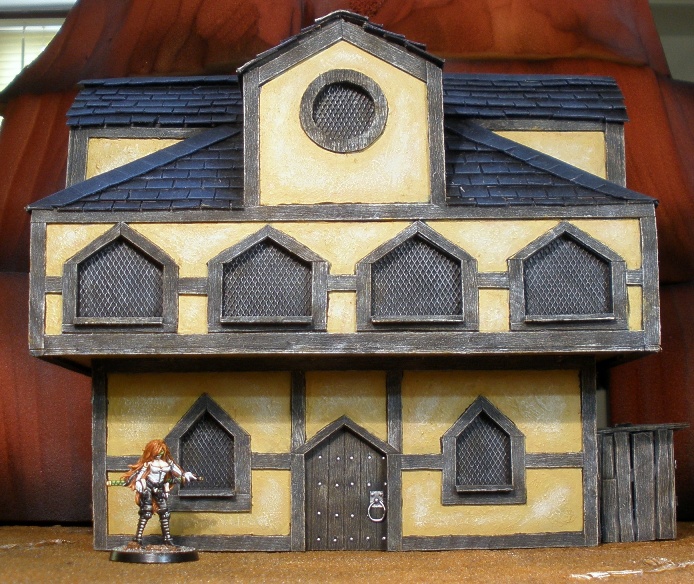
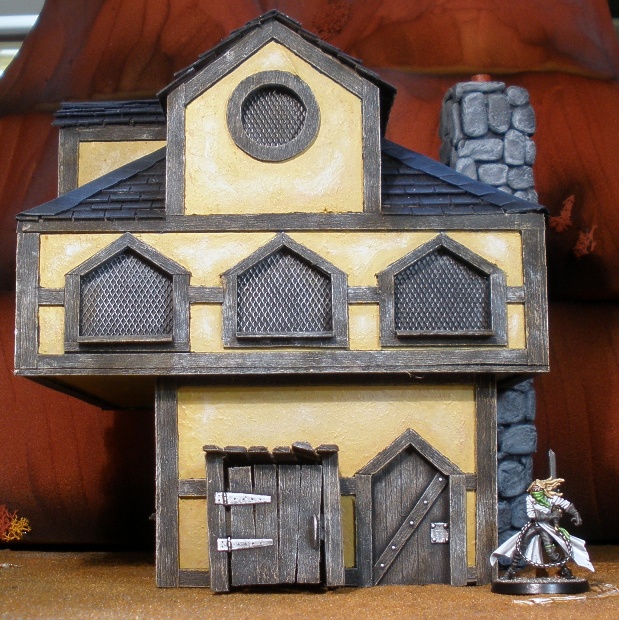
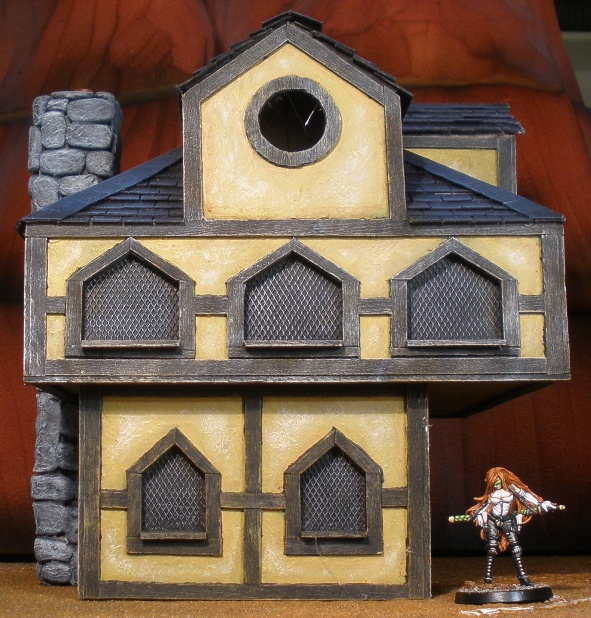
Obviously its a fantasy building of indeterminate sort.  Its quite large as these things go, so its probably an inn or coaching house.

I put it together from scratch in 1995 as a project for a course that I was doing.  The scale is a little off for 28/30mm figs, but its close enough.

The privvy is cute. I am absolutely astonished that it has survived intact for so long. Its 100% balsa construction makes it a bit like a city built on rock and roll: structurally unsound.

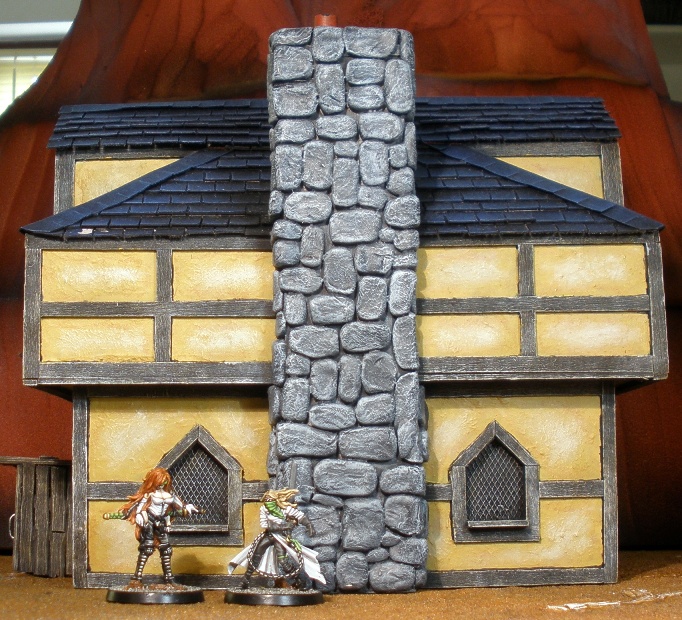
The piece isnt undamaged though.  Note that the circular window at the top of the photo above has fallen in to the structure.  The paint on the tiles is coming off in places in a disconcerting fashion too, as can be seen below along with the missing second chimney pot.  But all in all its in pretty good nick.

The chimney is made from air hardening clay applied in an effort to look like stone work.  The “stones” are a bit soft looking, but intact.

I am planning to fix some of the damaged areas and to add some light weathering.  I also plan to add a few posters to the walls plus a sign declaring the building a coach house or inn for use in Malifaux games.

I havent fully decided on a name for the establishment yet.  Considering the goofy steampunkhorrorvictorianwestern nature of Malifaux I am seriously considering naming it The Cowboy and Necrophiliac.  Thats what I have been calling Malifaux at home recently anyway (as in “Im off to play cowboys and necrophiliacs honey.  Dont wait up” or “I cant wait to get finished with this sexy nurse so that I can play cowboys and necrophiliacs with her on Tuesday when the lads come over”).

Admittedly The Cowboy and Necrophiliac is a bit of a mouthful, but it should make for funny signage.  Anyone have any better name ideas?


Baron Samedi

Baron Samedi

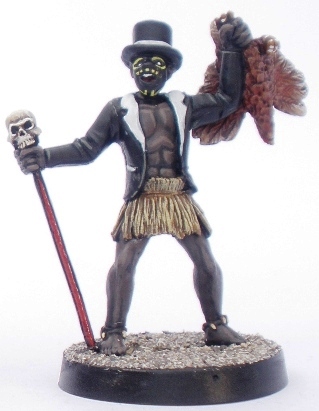
The Baron here was bought and painted for use as a zombie master in a variety of games.  The figure will also do well as a wyrd (psyker) for my Necromunda Goliath gang should I ever need one. Continue reading

Oyumaru/Instant Mold Casting

While prepping some figures for my ongoing Adeptus Mechanicus project I decided to cast up a replacement head for one of the figures.

Way back in the last century I made more silicon rubber moulds than I could count.  I also cast very many items in various resins in them, as it was a large part of my old job working in industrial prototyping.

A lot of people seem to enjoy using those industrial substances at home in their workshops, sheds and hobby rooms and good luck to those people: I hope that they enjoy it.

I on the other hand have no desire to invest time and money in such horrible, toxic and messy substances for use in my house.  Therefore any casting that I do has to be clean, easy and effective.  No vacuum pumps, no multi-part moulds, nothing very complex.  Push moulds and simple two part moulds for tiny items are the limit of my casting desires at the moment.

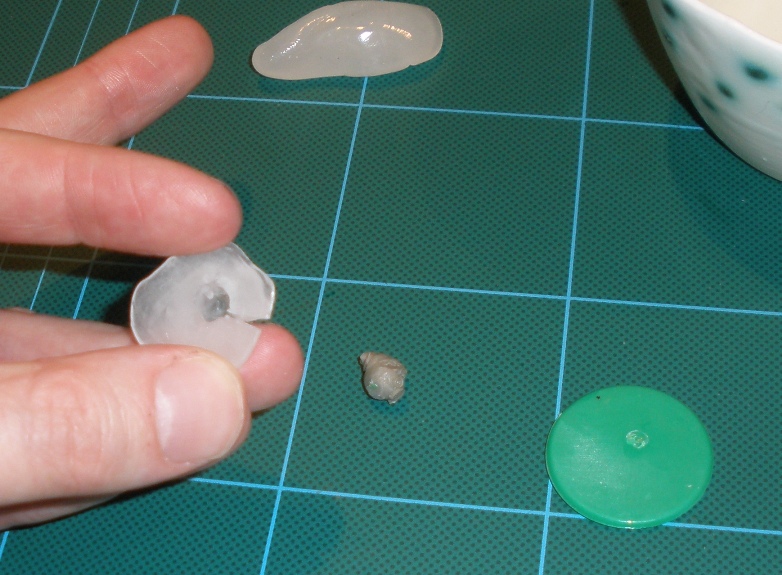
So I got some “oyumaru” (also known as “Instant Mold”) and used it as outlined below.  I used nothing but basic techniques and I wouldnt really describe it as a “how-to” or anything, but it might be of interest to someone.

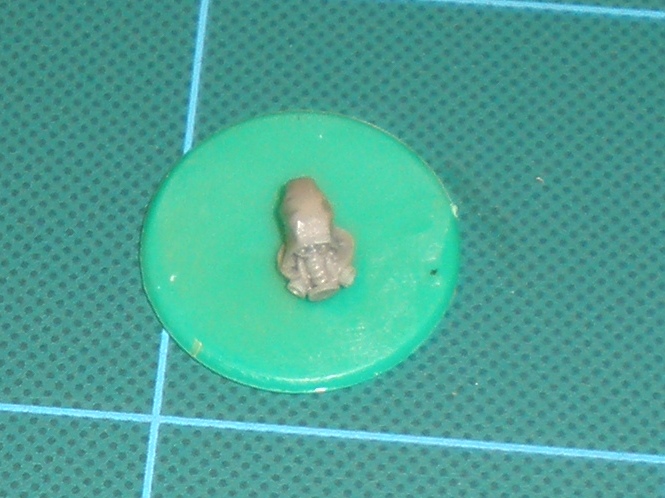
Firstly I selected the replacement part that I wanted to cast: its the hooded and masked head shown on the bottom right in the picture above.

Next I cleaned up mould lines and all of that, filed the underneath of the neck flat and stuck this flat area to a flat piece of plastic (a tiddlywink).

I attached the part to the tiddlywink as I wanted to make sure that I could get the mould rubber to cover the detail on the bottom of the part.  I found it easiest to stick the part to something flat to so that I could work the oyumaru into it while still maintaining a flat base to the mould.  I hoped that this would help to minimise distortion in the castings later while also making the part easier to handle.

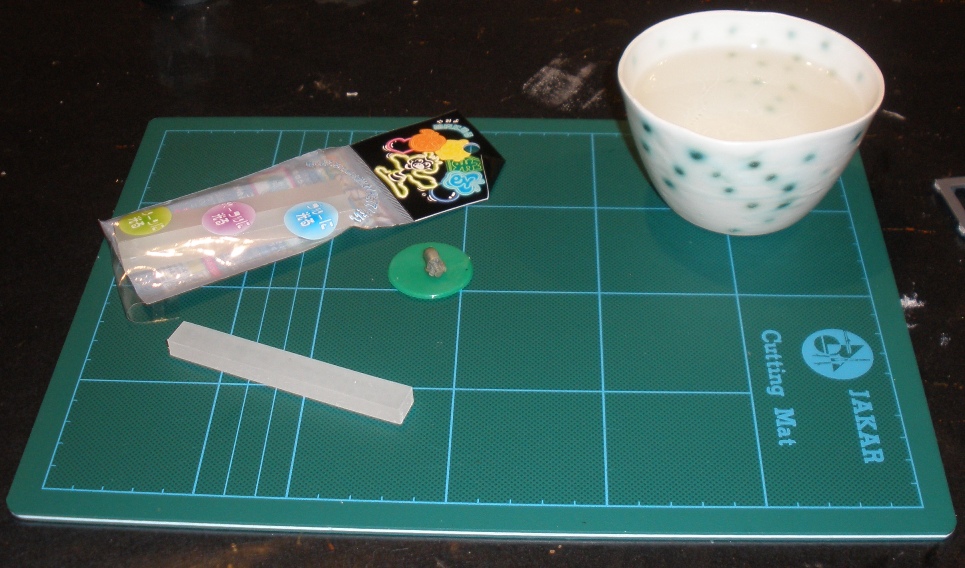
Next I got a small bowl of boiling water and the oyumaru.  The oyumaru is the waxy looking long rectangle on the left.   In its room temperature state it has a similar consistency to a low melt glue stick

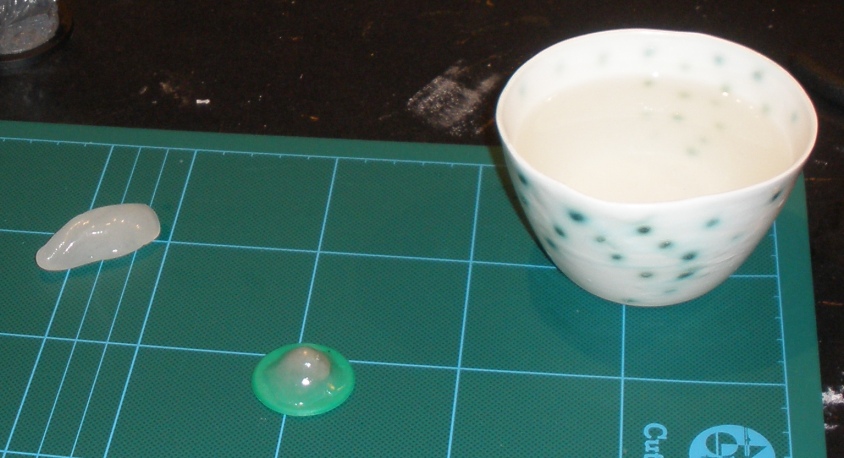
The oyumaru was submerged in the hot water for a minute or two at which point it became very pliant.  I quickly covered the part in oyumaru.  I ensured that I worked the material under the part and and against the flat plastic tiddlywink.  I also tried to minimise possible air bubbles in the detailed face area by working the oyumaru gently into those details as carefully as I could.

A few minutes later the oyumaru had cooled down and become rigid again.

I prised the part from the tiddlywink.  Then starting at the bottom where the part had been glued to the plastic I used a scalpel to cut through the side of the mould.

I went about two thirds of the way around the mould, gently cutting to the part as I went.  I didnt want to split the mould entirely in two as I didnt want the hassle of having to engineer some way of keying the two halves back together when casting.  Keeping the mould attached would help to minimise that.

Also of note is that I slit the mould from ear to ear across the top of the head, from the parts perspective.  As the head is hooded I figured that those areas would be the easiest to clean flashing and mould lines from later.  Obviously, splitting the mould through highly detailed or recessed areas would make cleaning up the subsequent castings far more difficult (as anyone reading who has ever had to clean a crappy mould line of the side of a miniatures head knows).

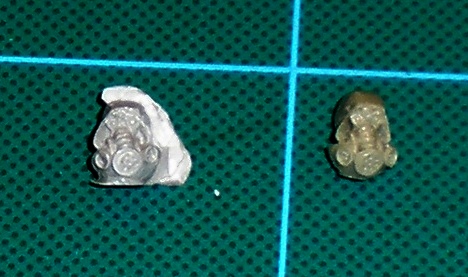
I then mixed up some two part epoxy putty (I used ProCreate, which is essentially grey coloured “Green Stuff”) and pushed that into the mould.

Like when making the mould itself, I was careful to make sure that as much of the detailed face area was filled as possible.  The part as it came out of the mould is on the left.  Note the flashing from the cut side of the mould.  Although it looks bad in the photo it really is only a fraction of a millimeter thick, so it took only a moment to remove.

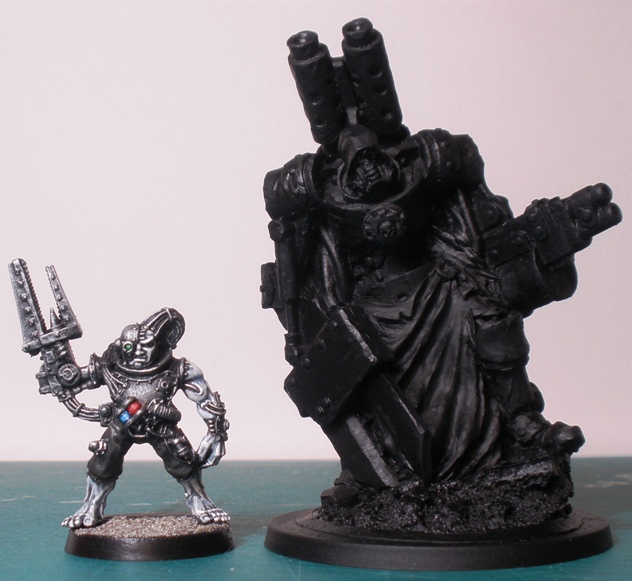
Above is a quick snap of the newly cast head in its new home.  As you can see its a pretty huge figure (from Ramshackle Games) which is why I included the Servitor for comparison.  The size of the target figure isnt really releant anyway, the piece cast was a standard 28mm heroic scale head.

Like that head, the Adeptus Mechanicus cog on the big models chest is also made of ProCreate via an Oyumaru push mould.  That also came out pretty well.

My verdict on this stuff is that its brilliant.  It provides a very simple, low outlay and non-toxic way to replicate miniature parts.  I see this as being part of my hobby toolbox for good.

Malifaux: Lady Justice

Lady Justice

Lady Justice is in charge of the Death Marshal elements of the Guild in Malifaux.  She is a blind, Buffy the Vampire Slayer type cowgirl who, judging by that massive hairdo, moonlights as an eighties rock star…

I bought my Death Marshals box before I had any interest in playing Malifaux.  I bought it because of the cowboy aesthetic that the other figures in the box have.  The Lady Justice figure was not originally a draw for me.

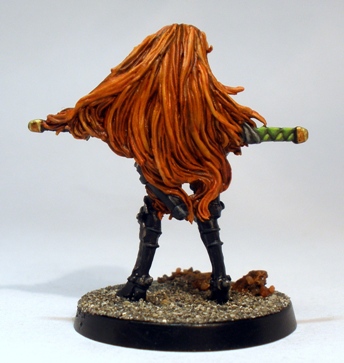
The sculpting is very nice technically but the subject matter and design initially left me cold.  In particular the massive amount of hair on the figure, which spreads left and right to span the length of her sword gives the figure a lozenge shaped silhouette, which doesnt really appeal.  From behind the miniature looks a little like Cousin Itt.

Click for image credit.

Lady Justices voluminous barnet also obscures her scabbard, the strap suspending her scabbard, bits of her fingers and elements of her pistols and holsters in a confusing way.  And I dont just mean confusing to paint (which it was).  I mean confusing in the sense that depending on how the figure is painted and the colours used it can be very hard to see whats going on.

This view is pretty much all that I ever see when I play games with Lady J.

And yet, despite my apathy towards the figure initially,  as I painted Lady J it all started to make sense.  To start with I had difficulty imagining what colours to use as I wanted to make sure that the elements somewhat lost in the hair would be visible and identifiable.  I also wanted the figures palette to tie in with the other figures in the crew but without making the figure too gaudy.

But, as I decided to embrace the (as I see it) eighties rock vibe I found the figure easier to work on.  As I painted my original attitude turned around 180 degrees.  I went for the vaguely Dick Turpin, somewhat Adam Ant and definitely Meat-Loaf-one-minute-into-the-video-shown-below look shown and ended up quite happy with it.

By the time that I finished painting the figure I was really quite pleased with both how it turned out and with the design of the figure overall.  I dont remember my opinion of any miniature altering so drastically during painting before now, but in this case it did.  And it all turned out pretty well I think.

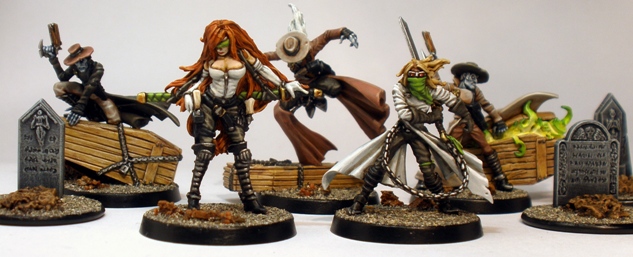
Here is a group shot of my first completed Malifaux faction, the Lady Justice crew.

Lady Justice Crew

Incidentally, the three gravestones were prepped for use in the game when the Death Marshals “bury” opponents in those magic coffins that they lug around.  I dont know if they will be of any use when playing, but they were fun to make anyway.

Comments and criticisms all gratefully received.