C.D. Business

CD1

I am currently playtesting a Ganesha bug-hunt game called “Swatters”.  Unlike the majority of Ganeshas games Swatters is squad rather than skirmish based.  Squads and various terrain and objective elements in Swatters are defined by a “Cohesion Distance”, conveniently represented by an old compact disc.

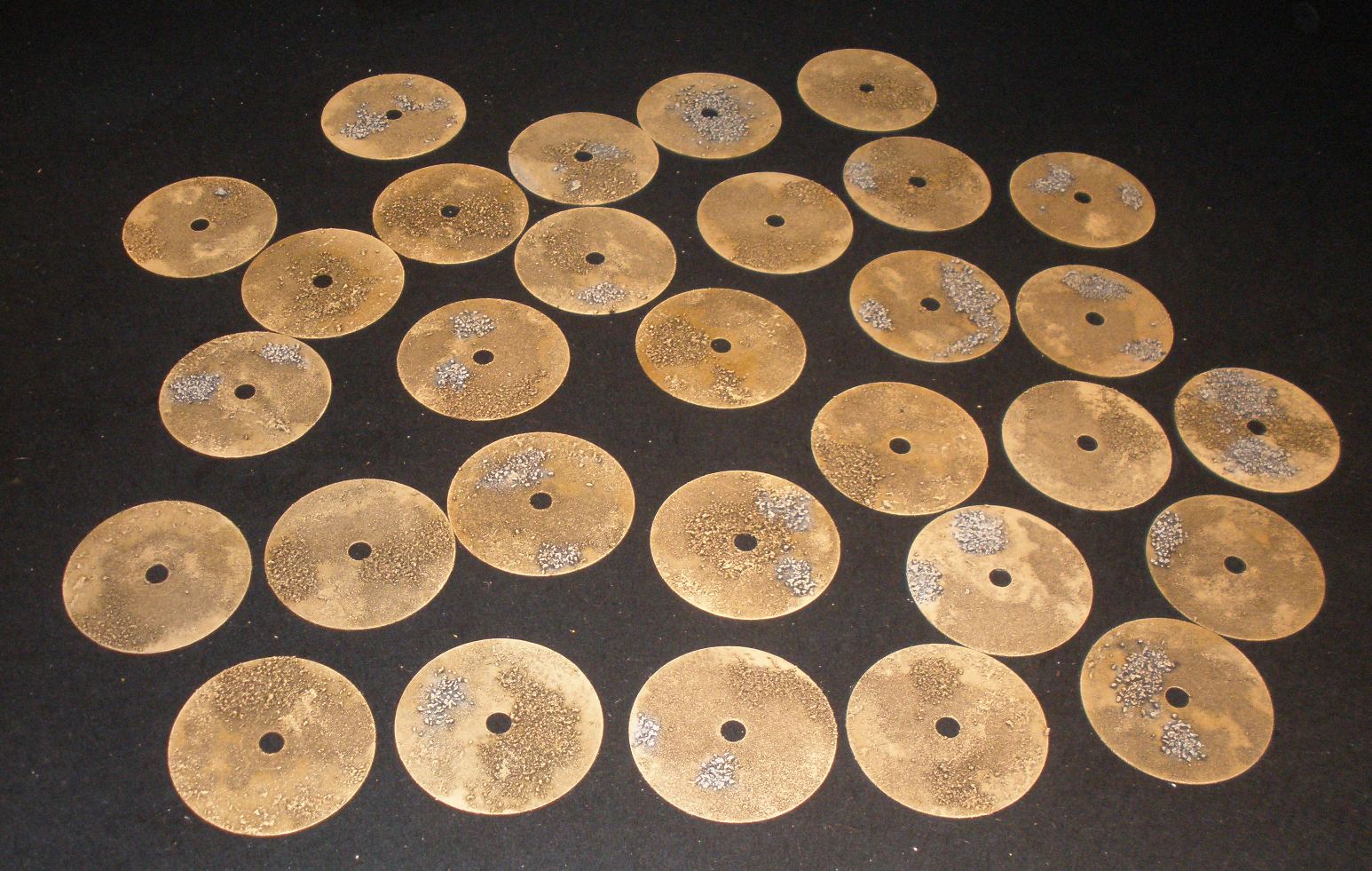
As can be seen by the ugliness of the shiny CDs used in the first days playtesting I needed to make a number of old CDs look a little less shiny and ugly and to try to match them to my Zuzzy mat gaming surface.

In excruciating detail, interspersed with reasons why I did the things that I did, this is how I did it.
CD2

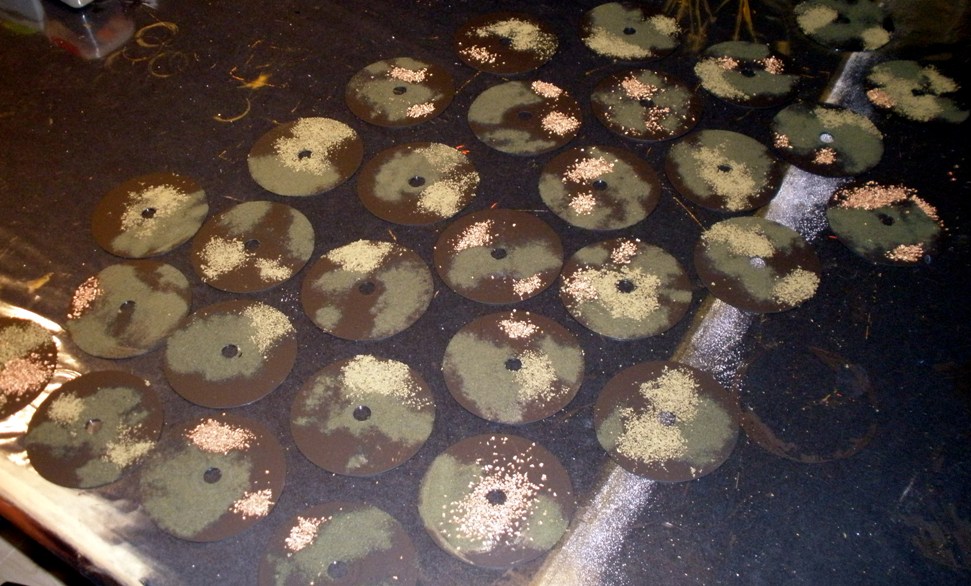
Firstly I sanded the shiny side of thirty CDs with coarse sandpaper, to give the paint/glue something to grip to.  I didnt bother taking photos of that stage.

I then mixed up a batch of black paint (I used black gesso as I had some around and gesso is designed to give additional tooth to paint anyway), ready mixed filler and PVA/white glue.  This mix was then painted all over the sanded side of the discs.  I then sprinkled two different kinds of flock and some granulated cork onto the wet paint/glue mix in patches.  I then left the lot to dry overnight.

Keen eyed observers will have already noticed that I didnt cover up the holes in the CDs.  I didnt bother for a number of reasons:

  • Its an awkward and time consuming job.
  • I did something similar using tape many years ago and the tape started to lift halfway through, which was an epic pain in the ass that I did not want to repeat.
  • It can be hard to cover the holes without leaving a trace of the method used behind that inevitably shows up in an irritating fashion when painting later.
  • The hole in the middle makes the discs much easier to hold while being worked on.
  • The hole will always be easily covered up by a miniature during play.
  • I plan to use the hole to store the CDs when finished.
CD3

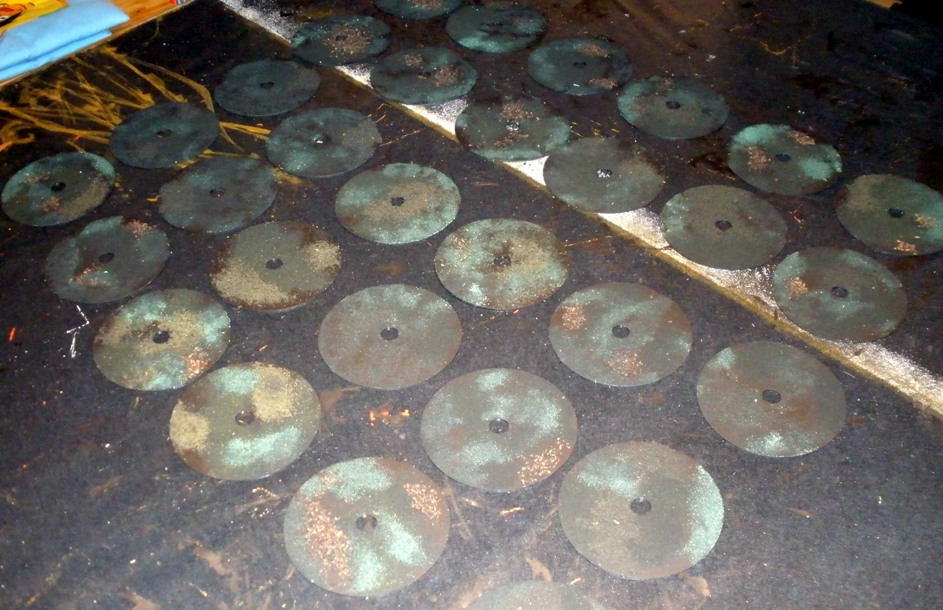
The following evening I thinned the paint/glue/filler mix that I had already made with water and applied it liberally to the flocked areas.  This was in order to both colour the flock and to seal it so that it doesnt fall off when used.

At this time I also sprinkled another grade of flock kindly donated by COM onto the balder parts of the CDs.  This flock was fine enough to absorb the paint/glue/filler mix as I applied it, so it didnt need to be sealed again afterwards.

Even though I usually base my figures with sand from a local beach, I wanted to use flock on these bases.  The primary use for the bases is to work as movement trays for miniatures and as such miniatures are likely to fall over on them from time to time.  I wanted to ensure that the textured bases were relatively soft and less likely to chip the miniatures than sand.

I used to have a gaming table covered in sand at one point and it regularly caused miniatures to chip.  It also caused bleeding knuckles from picking up dice.  Although the idea of a room full of nerds playing so hard that our fingers bled is kind of funny (and reminiscent of Bryan Adams lyrics), it was mainly a pain in the ass.  So flock this time then.

I let the flocked and sealed CDs sitting on the table to dry overnight again.

CD4

The first step the following evening was to break out the foam paint roller (visible top left above) and to roll the base paint colour that I use for my terrain bases and for my wasteland Zuzzy mat onto the CDs.  It was important not to have too much paint on the roller at this point as it was an overbrush effect that leaves dark paint in the recesses that I was going for.

I considered adding some other colours in patches beneath (like how I approached painting the Zuzzy mat last year) before I got the roller out, but decided that at best it would be effort that wouldnt be seen (as the discs would be covered in miniatures during games) and that at worst it might actually make the neutrally coloured bases a bit gaudy and therefore potentially detract from miniatures put on them.  So I didnt  do that.

If gluing junk and fluff to CDs and painting them has a fun bit, then this stage is it.  I was pleased to see how the broken ground effect that I was going for was working out and unifying the colour makes that sort of thing visible.

I then mixed some white into the colour and rolled that onto the discs, but using a lighter touch than the previous layer so that it would work as a highlight.  Lastly I mixed a mid grey with black and white and added some of the base brown to it and brushed some of the rougher areas in that colour to make it look like scree or similar.

The finished CDs can be seen in the first picture in this post.
CD5

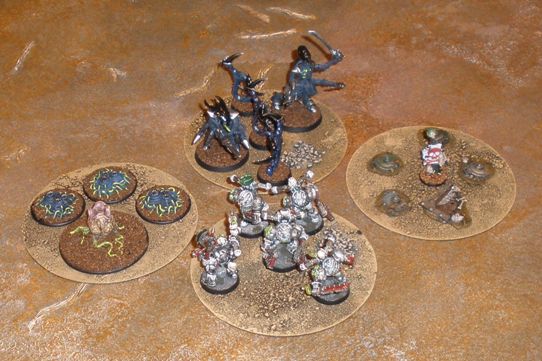
Clockwise from top: Bugs, a minefield, Sin Eaters Chaos Space Marines, a bug spawn point/objective.

Many people use CDs as bases for terrain.  CDs are pretty much impossible to warp and they are very cheap/free.  Regardless, I was put off using CDs as bases until now because of their uniform, perfect circle footprints, which I find visually jarring.
CD6

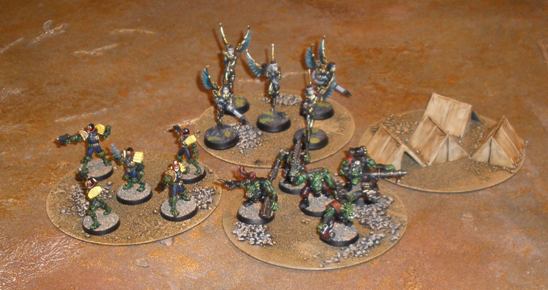
Clockwise from top: Swooping Hawk Eldar, a campsite, an Ork mob, some Mega City Judges.

Despite my reservations I couldnt help but plonk down some various small terrain pieces on a few of my finished CD Swatters bases to see if they helped to delineate a minefield or campsite or whatever, which of course they did.  So the CDs will likely have more uses than just as movement trays in games of Swatters.
CD7

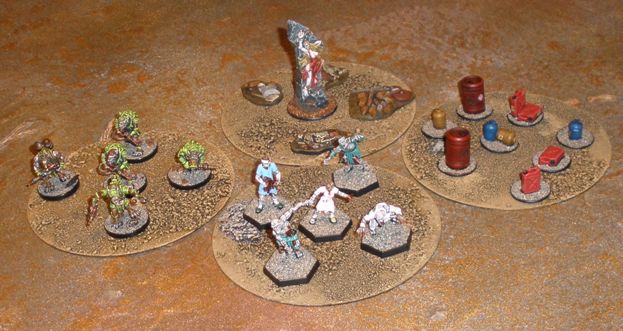
Clockwise from top: a human sacrifice, a load of things that can explode, some dead people who have escaped from hospital and a unit of ratmen from space, ratmaning it up.

Large terrain pieces that are lovingly modeled onto their bases/CDs are nice to look at but difficult to store and often hard to actually game with.  Therefore I tend to make small terrain pieces that I clump together to represent a woods or a ruin or whatever.

This approach works adequately, although it is handier if the area represented by giant mushrooms/unexploded bombs/an interdimensional vortex is represented physically in some way.  So thats another use for these thirty CDs.
CD8

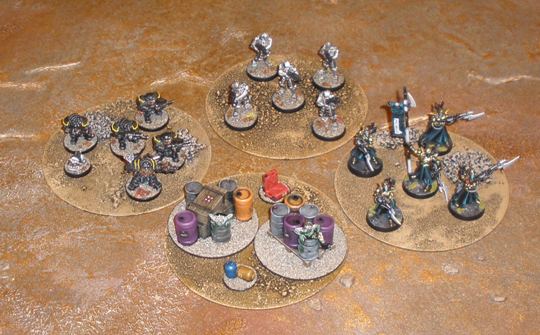
Clockwise from top: skeleton robots, Eldar Guardians, zombie spawn points conveniently located near butane cylinders and gas cans, squat space dwarf forgefathers.

The sand that I have used to base miniatures for a few years now is chosen to be neutral, so that it looks passable primarily on my urban and wastelands terrain sets.  As you can see above the sand isnt a perfect match for the CDs or the mat, but its not very jarring either.  Its an acceptable compromise, although its a bit extreme on large areas like the zombie spawn points above.
CD9

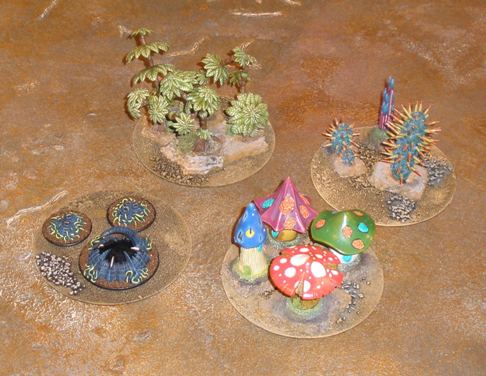
Clockwise from top: some jungle, some cacti, some fungus and an area that belches forth unspeakable horror.

A final issue that I have with terrain pieces regards storage.  I am lucky enough to have quite a bit of space assigned to my hobby stuff, but I still need to make sure that the things that I make can be stored reasonably well.   One of the reasons that I didnt cover up the holes in the CDs is so that they could be returned to the spindle that they were supplied on.

CD10

Very tidy.  Unlike this meandering, huge blog post.

Woods

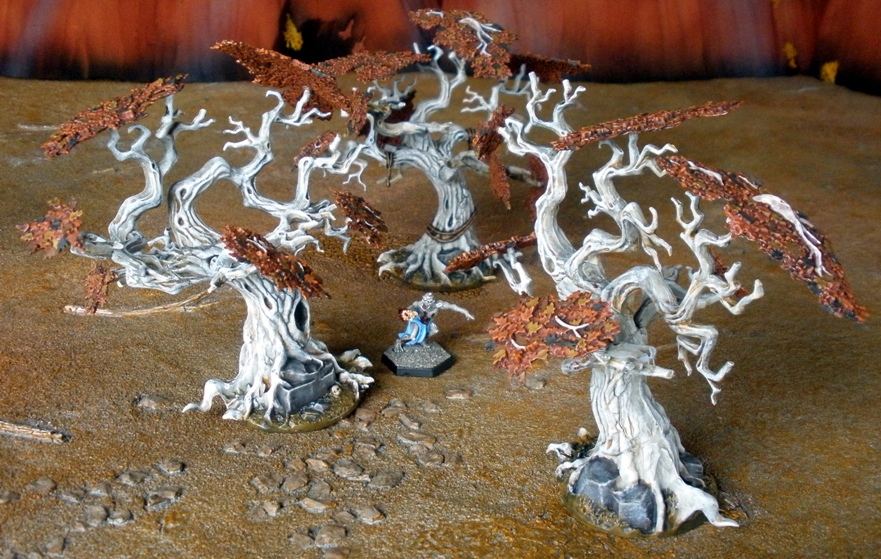
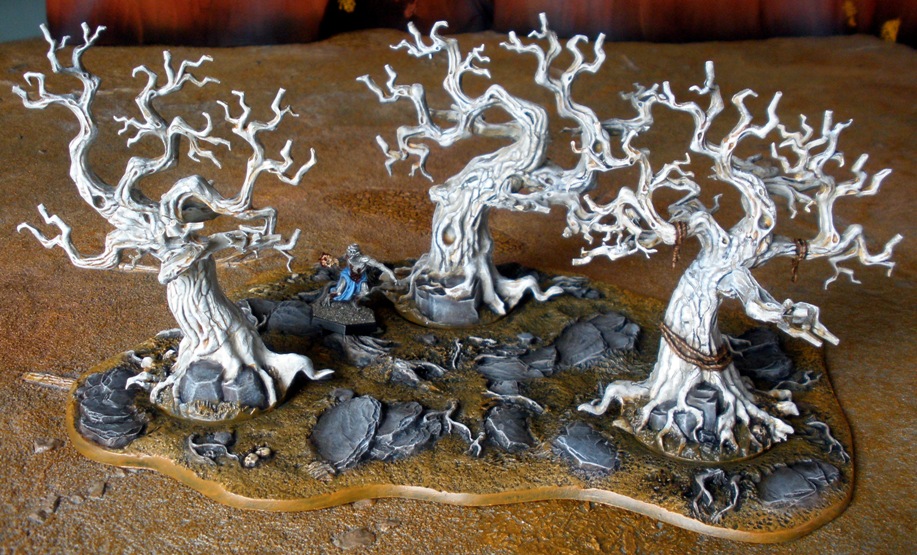
I recently picked up a set of the plastic Citadel woods to add to my graveyard.

The trees in this set are like something from Sleepy Hollow, with their Brothers Grimm, Tim Burton aesthetic.  Very suitable for inclusion in my graveyard terrain in other words.

My graveyard is painted to match my wasteland terrain set and so I painted the trees to match the dead bits of wood that feature on my Scourged Forest gaming mat.

I had originally planned to leave the trees devoid of the foliage pieces supplied but when I assembled the kit I decided that I liked the unusual looking leaf pieces too much to simply leave them in the box.

In a moment of madness I decided to add magnets to a number of the tree branches with corresponding magnets inset into the underneath of the leaf pieces.  Now the trees can reasonably represent both autumn and winter or living and dead.

Sort of fun to do?  Yep.  Easier to store as a result?  Probably.  Worth the trouble?  Nope.

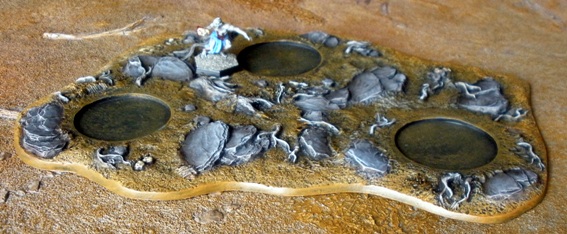
Like the trees themselves I painted the large plastic base supplied to match my gaming mat.  I dont think that I will end up using the base very often as I plan to use the trees as freestanding single pieces.  Nonetheless I figured that I might as well paint the base alongside the trees anyway: who knows when I might decide to use the woods in that fashion?

Lastly the tree above (which I showed along with Santiago a while back) got painted at the same time as the GW set.  Its a plastic tree supplied with the Horrorclix starter set from a few years ago.

I based the tree so that it would have the regulation footprint for representing a “hanging tree” in Malifaux games.

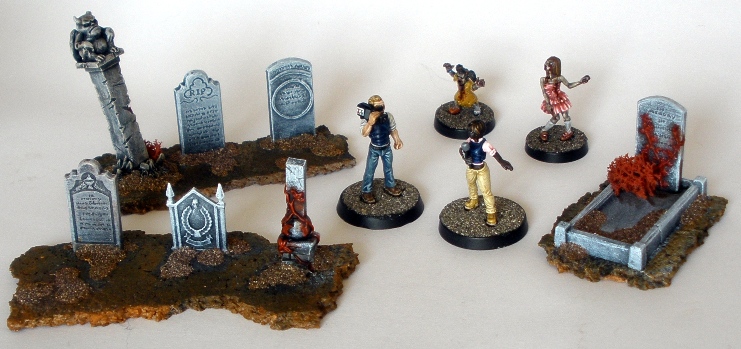
I am currently working on a another couple of sets of Renedra gravestones to bulk out the graveyard set, then I will be fully finished with it.  Once I am done with those I will try to get some half decent photos of the whole thing set up for a game.

More Graveyard


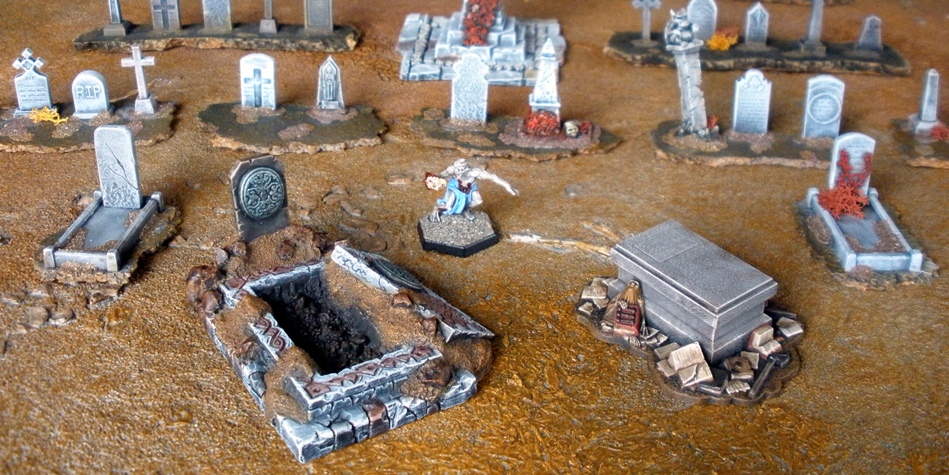
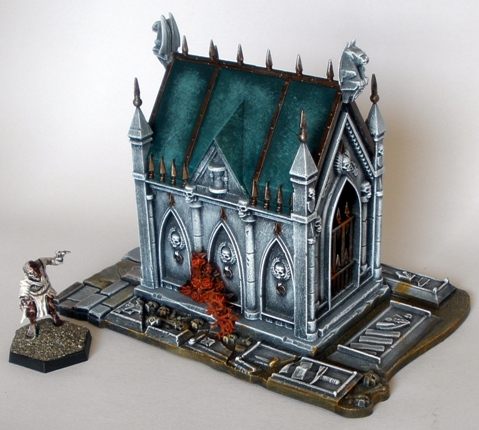
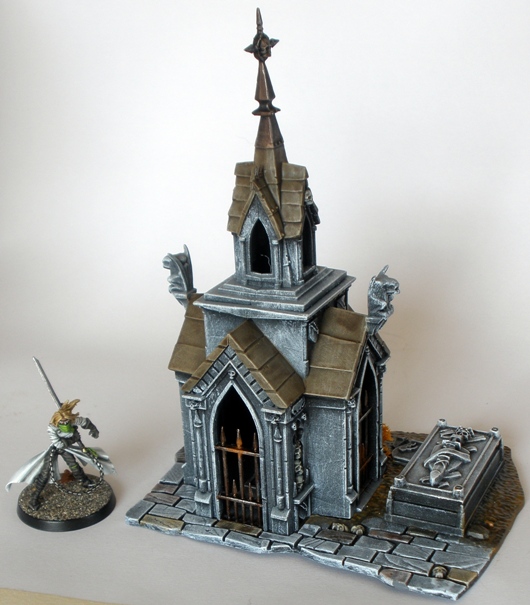
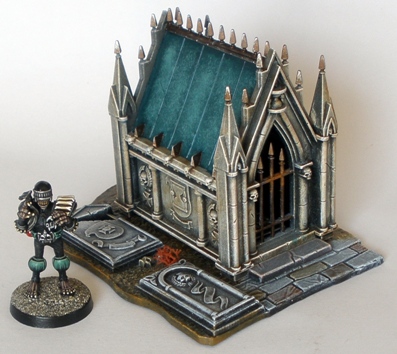
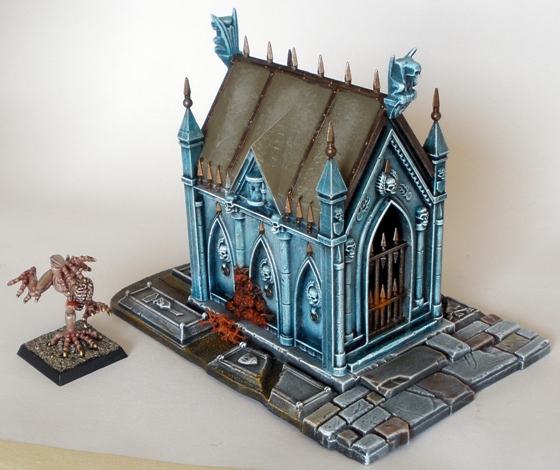
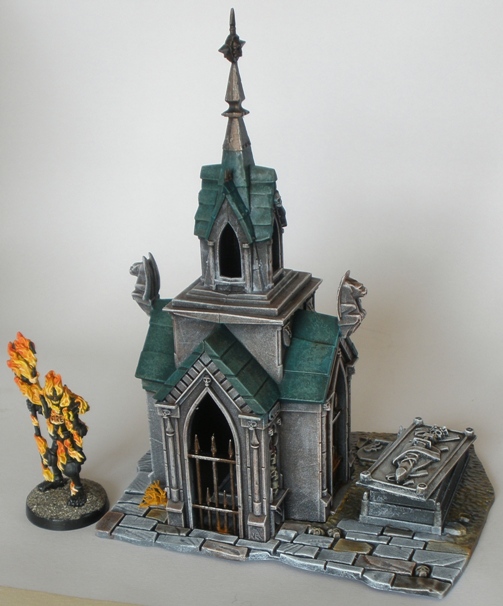
I recently got another couple of items finished for my graveyard, the open grave and the crypt in the foreground of the picture above.  The photos are a bit poorer than usual Im afraid, as I dont have a set up decent enough to take photos of anything much bigger than a 28mm figure for the time being.

The one on the right is a plastic piece that came from one of the GW Lord of the Rings boxes, kindly donated by PB a few years back.  I sprayed it with GW Roughcoat back then which was a mistake as it obscured some of the details on the lid of the sarcophagus.  I enjoyed painting the books strewn around the base.  I like painting miniature books for some reason that I havent quite worked out yet.

I traded some bits and pieces with COM in exchange for the resin grave piece above.  I dont know where it originally came from, but I think that its a Grendel piece.  In my haste to get it finished the painting came out a little more lurid than I had intended.  I am tempted to go back and tone it down a bit but I probably wont.

The piece originally had a tombstone, but that was mislaid at some point before I got my hands on it.  I made up the stone shown with an old piece of Foamex board that I had lying around since 1995.  I used Instant Mold to copy the pattern on the sarcophagus lid and stuck the copy to the Foamex as a quick way to make the headstone look a little more authentic.

Artificial Boundaries

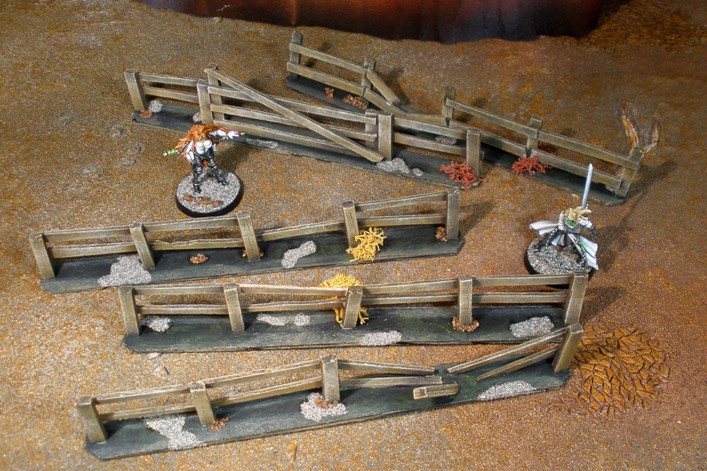
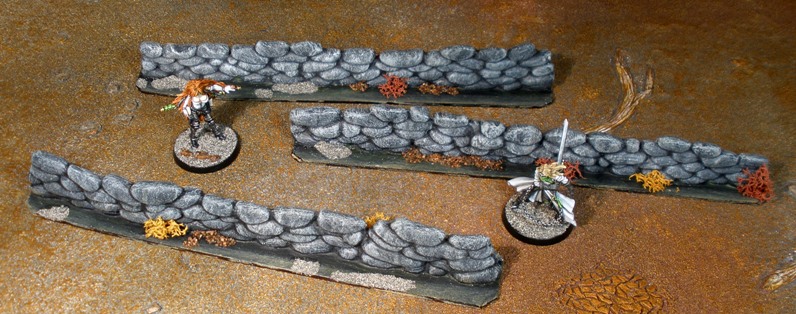
My recent mancave renovation unearthed a few bits and pieces that had been forgotten over the years.  The fences and walls shown here had been sitting in a box since 1992 or so.

Regular readers (there are some, honest) will know that I pretty rarely play fantasy games, preferring to focus on science fiction.

One of my (many) pet gaming peeves is the tendency for players to dump any old bits and pieces lying around onto their gaming table to serve as terrain, regardless of the setting, resulting in jarring suspension-of-disbelief juxtaposition.

Space troopers fighting alien bugs against a backdrop of tatty cardboard tudor buildings is a classic example. with regiments of yellow clad, ruffle-sleeved, twirly moustached pikemen wandering past ruined gothic city blocks being another unfavourite.

I have christened this The Doctor Who Effect: no matter what is going on in that show it always look like its happening in Wales instead of an asteroid circling Proxima Centauri or whatever, which I find very distracting.

I honestly dont understand why anyone interested in the imaginary and compromise filled world of miniature gaming is bothered playing if the game doesnt have some sort of visual narrative, of which the terrain is a crucial part,  Whats the point otherwise?  Appropriate terrain is at least as important as the toy soldiers themselves.

Which is a roundabout way of saying that despite having made these terrain pieces twenty years ago, I havent played many games that required either rickety wooden fences or somewhat unconvincing “stone” walls.  Until now that is.

My recent foray into playing Malifaux has meant that these terrain pieces have come out of retirement.

The fences are strips of balsa glued to each other and based on card.  The walls are balls of air hardening clay stacked into soft looking rustic walls.  Nothing fancy, but functional all the same.  It is satisfying to use the pieces properly for the first time in nearly two decades.

Since I took these photos I have gone back and stippled some colour onto the bases to get these pieces to fit into the Zuzzy mat baseboard colours a little better.

St. Craniums Cemetery

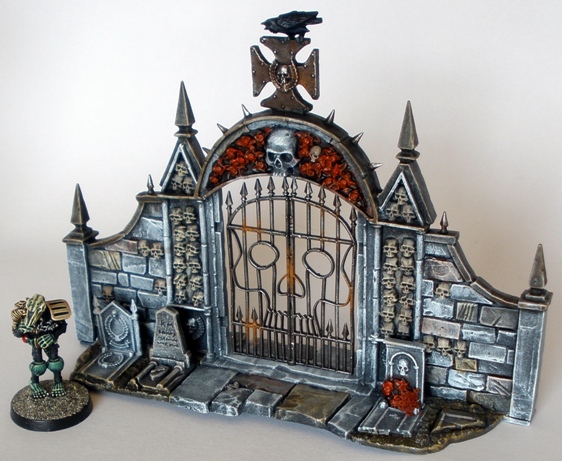
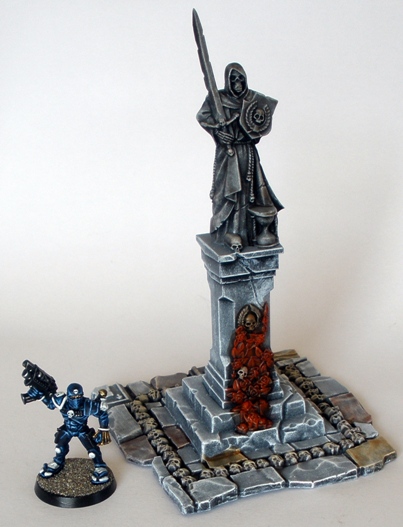
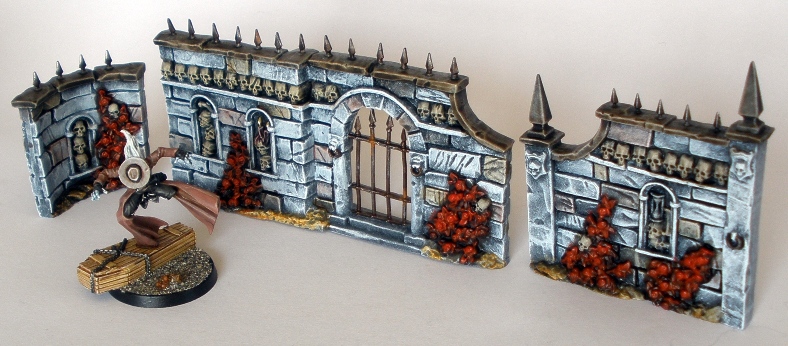
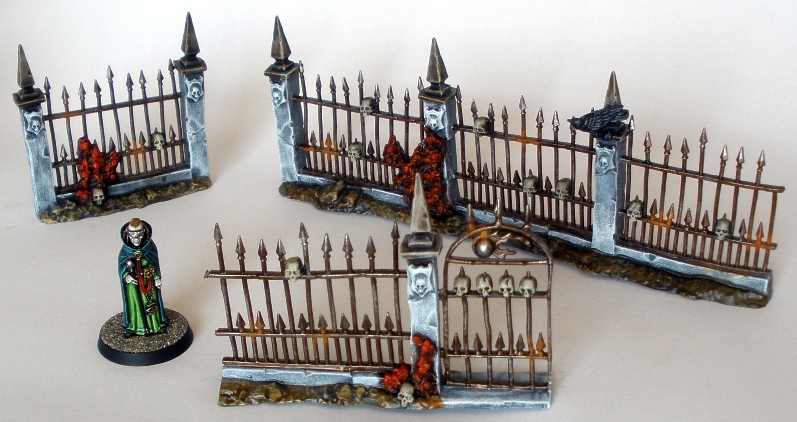
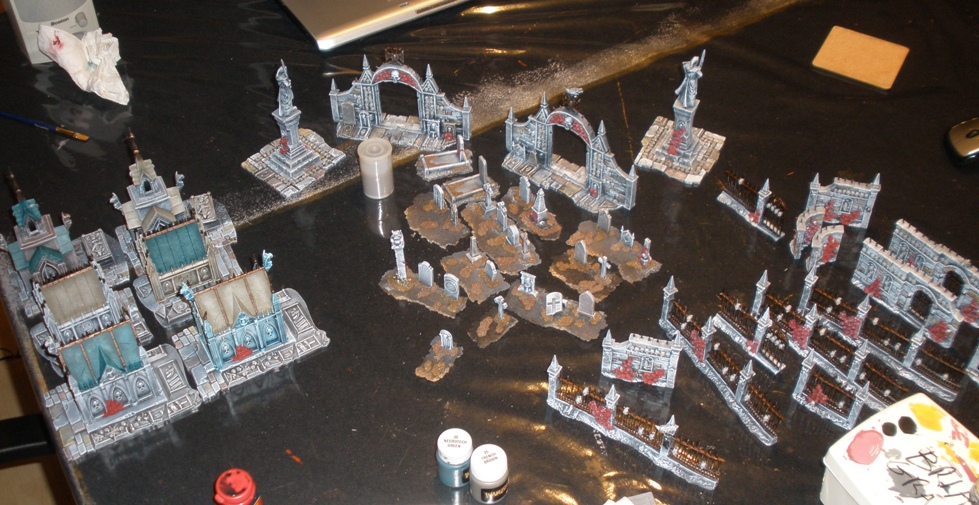
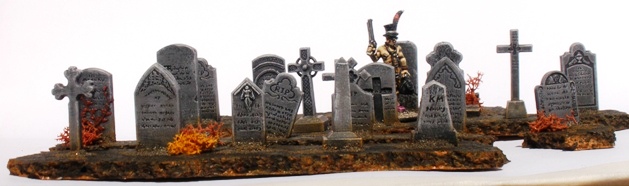
Following on from Mondays WiP post here are some close up shots of some of the finished graveyard elements.

A few meandering points:

  1. I wanted to avoid green plants.  Therefore I went with rusty red on the undergrowth to get the terrain to fit in with the rest of my wastelands stuff which in turn matches the bits of lichen that I attached here and there.
  2. I am particularly pleased with how the mausoleum roofs worked out.  I am also happy with the three crows that feature throughout the piece.   By using a different technique to the last time that I tried to paint black birds they came out much better.  Its a very minor thing, but satisfying for me.  Sometimes it really is the little things.
  3. The large skull-faced gates (one of two shown) are both magnetised so they can be removed as and when required for game purposes.  I considered leaving the gates permanently open, but adding the magnets was more fun.
  4. I went for a walk around a local overgrown graveyard and took some photos in preparation for painting this stuff.  As It happened I simply went for the easy, more theatrical approach to painting the pieces rather than trying to duplicate complicated patterns of wear and plant growth on the pieces.  The end result is more Scooby Doo than some might like.  Visiting the old graveyard turned out to be interesting in itself anyway, even if it had little influence on how the models finally turned out.


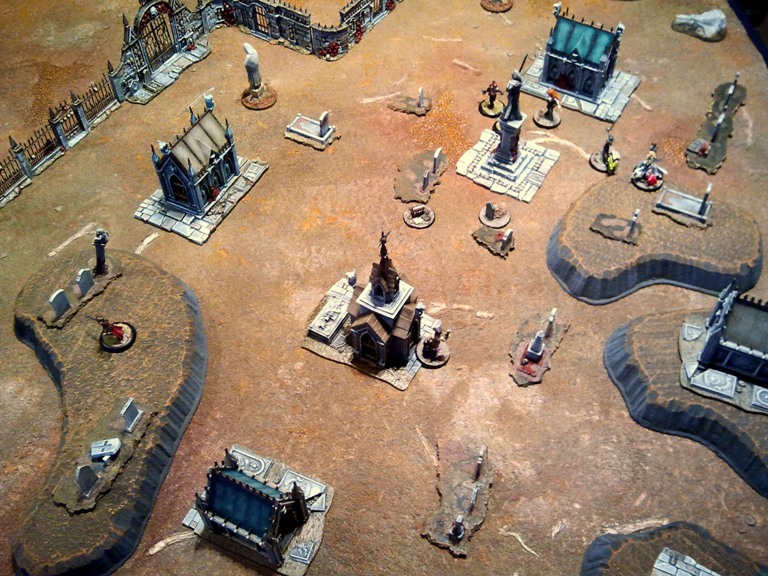
Since I finished these I have dug up a few more bits that will be getting painted up to go with this set, but for now I have plenty to game with.  In fact I played a game with COM on the brand new graveyard terrain within hours of finishing it, which was satisfying.

Graveyard WiP

I have wanted a graveyard terrain set to game with for many years, but I never got around to picking up the many expensive crypt, mausoleum, gravestone and perimeter pieces required.

Then Games Workshop released the Garden of Morr graveyard kit last year.  It looked like a convenient and reasonably cost effective way to cover my toy soldier graveyard needs so I picked up a couple of sets last Autumn.

After some consideration I decided that I would prep the graveyard to fit with my wasteland terrain.  The classic movie graveyard tends to be a bit greener than that and for a while I was tempted to go for that more Transylvanian look.  I have a bit of an aversion to playing games on green, golf course like tables however and as I had already painted up some Renedra gravestones that I picked up at Salute last year to match the wasteland terrain, I went with that again here.

The Renedra gravestone kit is straightforward and very nice.  The Garden of Morr is fantastic.  It goes together very easily without need for clamps or rubber bands or anything fiddly.  It also looks really nice when assembled, even before painting.

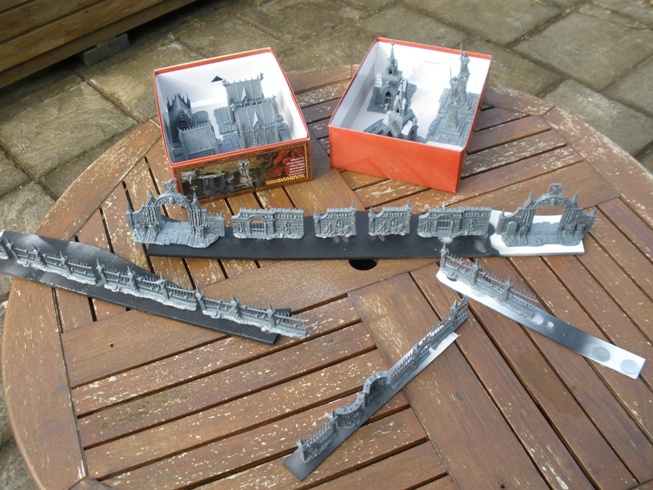
The painting process took me a few hours each day for about four days or so. I tend to be slow at things like this so its possible that some time could be shaved off that I reckon.  Below are the steps that I used to prep the lot, which should give anyone interested an insight into how I approach projects like this, for better or for worse:

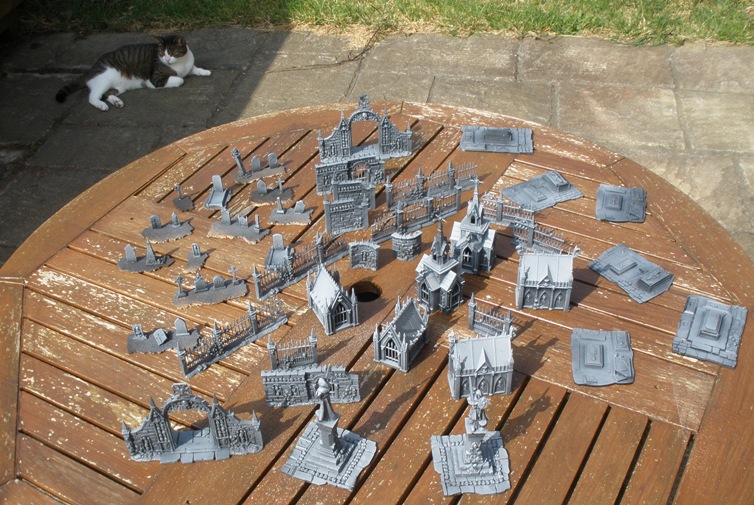
Parts were clipped from the frames, mould lines and the like were cleaned off and the loose gravestones were attached to cork tile bases.

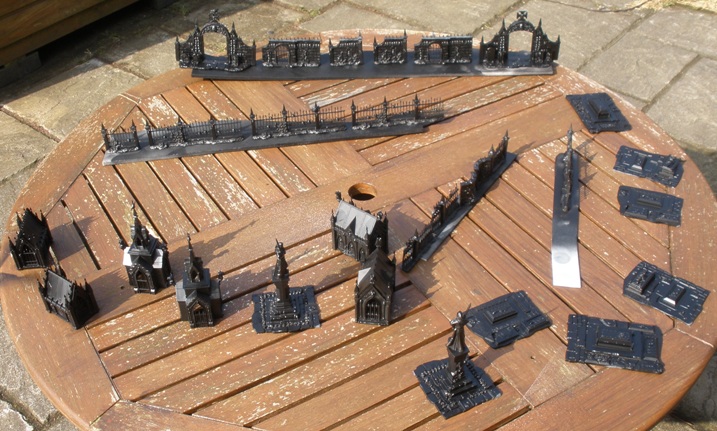
Everything was sprayed with matt black acrylic car paint.

Next all of the pieces were lightly sprayed with grey primer spray from above.  I recently read somewhere that the kids call that “zenith highlighting”.  Who knew?  Cat provides cheerleading section.

All of the parts were then given a pretty heavy drybrush of white acrylic.  Note the Deadwood DVDs that were running on the laptop while I worked, helping to keep me in a cowboy frame of mind.

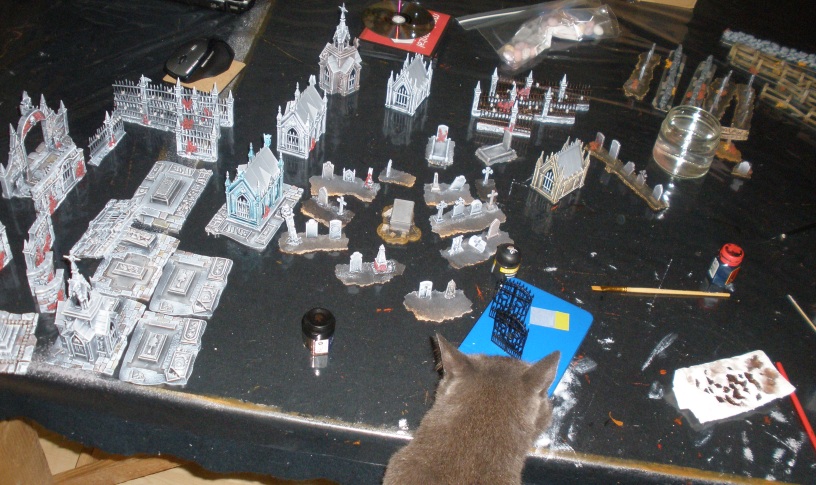
Some areas were tinted with washes of ink and/or thinned paint.  Detailing started in some areas.  Another cat provides aesthetic critique.  Note the DVD rental of Cowboys and Aliens which I had hoped would keep me in a Western frame of mind.   It didnt.  Dont watch it, its depressingly awful.  If I believed in souls then “soulless” would be an apt description.

More detailing. The most significant progress here was on the mausoleum roofs, although various other elements were also layered up.  This was usually done with a single tinted translucent colour so that the black through grey through white beneath showed through.  Painting GW Tin Bitz on the railings was the most tedious part of the whole job.

I am not really a GW basher: I have had plenty of fun with their products over the years even if I dont tend to have a whole lot of interest these days.  But there was a somewhat amusing element to this kit that I thought that I would mention.

GW products get a lot of stick about their propensity to stick skulls and skull motifs on any vaguely flat surface.   A graveyard seems to me to be one of the few places where its possible to get away with that sort of thing, but the GW designers decided to go berserk with skulls on the Morr kit.

Out of (morbid) curiosity I counted the skulls and skull motifs on the set.

A Garden of Morr features:

  • 244 “human” skulls
  • 115 skull motifs
  • Total 359 skulls per kit

I assembled two kits meaning that I quickly painted a staggering 718 skulls.  Hilarious.

A few skulls here and there is fine with me as I am not going for a realistic looking, architectural style piece.  The sort of graveyard that featured in Buffy or Scooby Doo is what I was looking for.  Even so, that really a lot of skulls.

If the vast amounts of head bone on the kit dont bother you then I thoroughly recommend it, its very practical in game terms and it assembles very quickly and easily.  I would not recommend buying the kit with the intention of removing most of the skulls and skull motifs as it would be a huge pain in the arse.  I am sure that some people would do it, but it would feel like a waste of time to me.

Photos of the finished elements of St Craniums Cemetery will be posted up on Wednesday.

Malifaux: Objectives

Malifaux play is geared around “Schemes” and “Strategies”.  While there are a small number of these that are based on simply battering the opponents forces, most involve holding areas or moving certain items.  These objectives are represented in game by 30mm diameter bases.

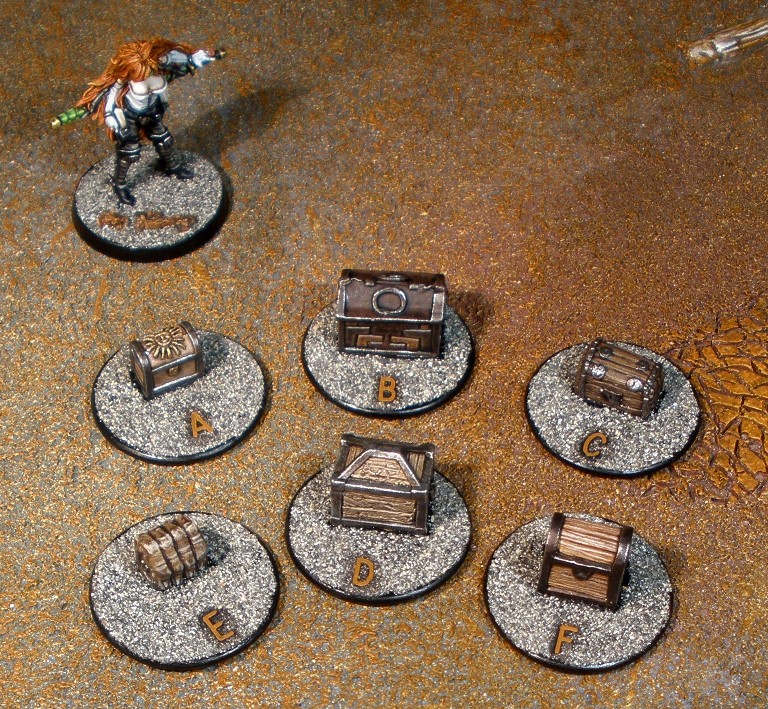
The treasure chests above were purchased in Games Workshop, Oxford St, London way back in 1989.  I originally bought the pack of ten (or perhaps two packs of five, I cant remember) for use in Dungeonbowl, a Blood Bowl variant which was… wait for it… played in a dungeon.  The chests languished in the lead pile ever since, only to finally be given some love this year, a terrifyingly distant twenty-three years later.

I added the letters in case I will at some later stage need to randomise the chests for whatever reason.  A brilliant and much more aesthetically pleasing way to achieve this (that I was too lazy to copy) was done on Phreedhs Miniature Stuff a while back.  Unfortunately I cant currently find that particular post on the newly organised blog (Mattias, if you see this then put a link in the comments if you would like to show off your lovely work).  EDIT: that link is HERE.

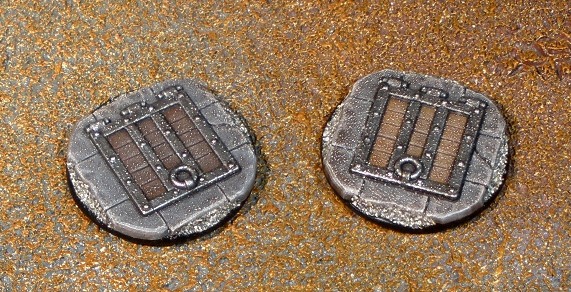
The next objectives are trapdoors that were supplied with some GW LotR stuff.  PB gave me a lot of the accessories from those sets as he knew that it was unlikely that he would ever get around to painting them and that I likely would.  It looks like he was at least half right.  Ta-da!

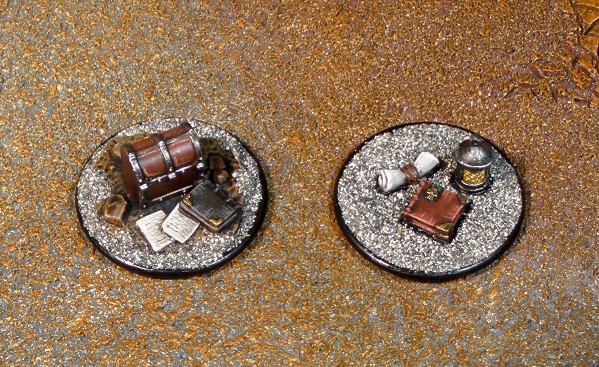
The two above are my favourites.  I think that they both suggest a little story and playing miniature games is all about story.

The left hand one is supplied as a tiny two or three piece kit which I then stuck to a base.  It is another LotR bit from PB.  The lantern, scroll and book on the base on the right come from a Mordheim sprue (I think that it was supplied with Empire Militia figures for a while subsequently).

I like making/painting small miniatures to represent these sorts of things.  Fighting over a little model of a forbidden tome or briefcase full of diamonds or other all-important Maguffin adds a lot to the atmosphere in a game and is far nicer than fighting over a scrap of paper or similar.  Little bits of set dressing help with the narrative and to me the game narrative is the whole point of the process.

The fact that modelling and painting these items can be quite fun and a good change of pace from painting yet another guy with a gun means that I tend to finish off a lot of these objective based items.

A quick look through the blog archives brings up the following list of similar items if anyone is interested.  I had actually forgotten that I had modeled and painted some of these: I tend to consistently get motivated to finish these mini diorama type oddments.

Scrap countersvulturesencampmenttentsgas cansoil barrels and butane cylinderszombie spawn pointsmines,bombs and boobytrapsaltars and tombsdistressed damsel, crows

Fixer Upper

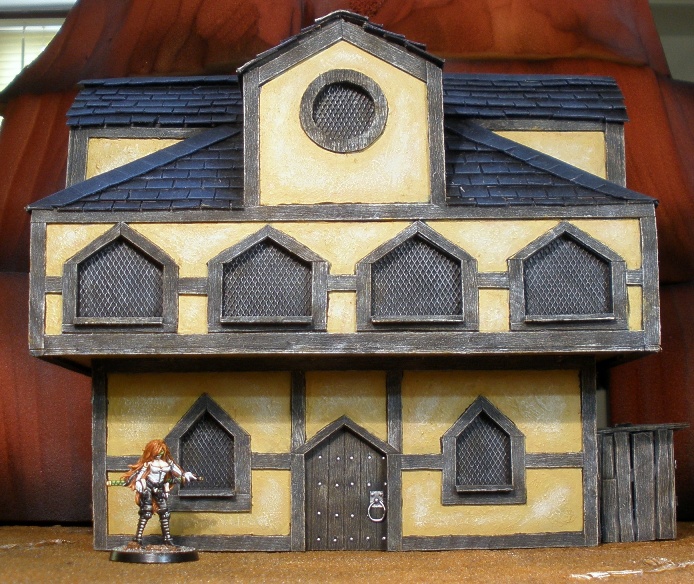
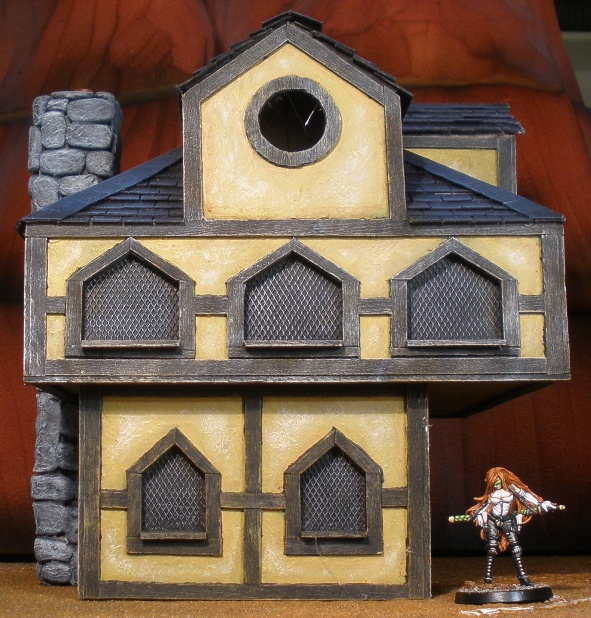
I found this model in a box in my mancave last week.  I had almost completely forgotten about it, even though the nondescript box that it lives in has been staring me in the face for seventeen years,

Obviously its a fantasy building of indeterminate sort.  Its quite large as these things go, so its probably an inn or coaching house.

I put it together from scratch in 1995 as a project for a course that I was doing.  The scale is a little off for 28/30mm figs, but its close enough.

The privvy is cute. I am absolutely astonished that it has survived intact for so long. Its 100% balsa construction makes it a bit like a city built on rock and roll: structurally unsound.

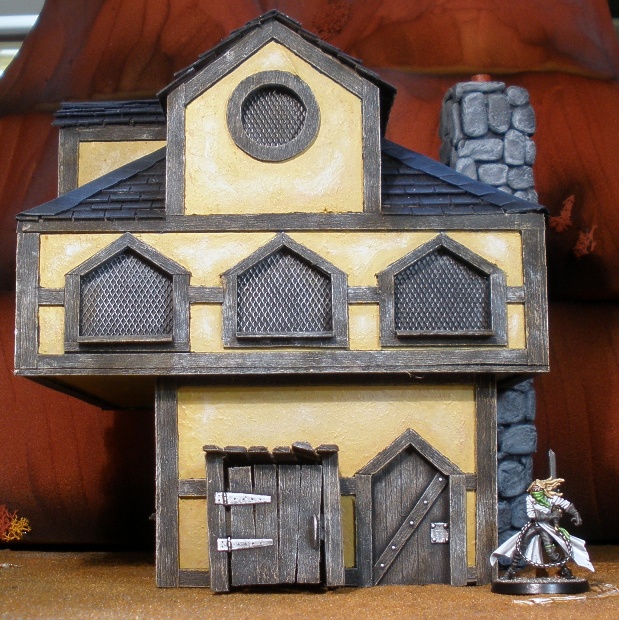
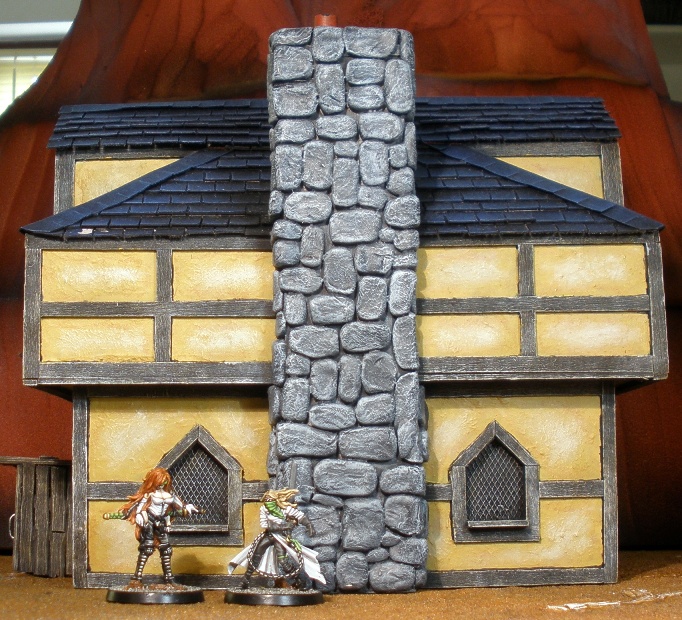
The piece isnt undamaged though.  Note that the circular window at the top of the photo above has fallen in to the structure.  The paint on the tiles is coming off in places in a disconcerting fashion too, as can be seen below along with the missing second chimney pot.  But all in all its in pretty good nick.

The chimney is made from air hardening clay applied in an effort to look like stone work.  The “stones” are a bit soft looking, but intact.

I am planning to fix some of the damaged areas and to add some light weathering.  I also plan to add a few posters to the walls plus a sign declaring the building a coach house or inn for use in Malifaux games.

I havent fully decided on a name for the establishment yet.  Considering the goofy steampunkhorrorvictorianwestern nature of Malifaux I am seriously considering naming it The Cowboy and Necrophiliac.  Thats what I have been calling Malifaux at home recently anyway (as in “Im off to play cowboys and necrophiliacs honey.  Dont wait up” or “I cant wait to get finished with this sexy nurse so that I can play cowboys and necrophiliacs with her on Tuesday when the lads come over”).

Admittedly The Cowboy and Necrophiliac is a bit of a mouthful, but it should make for funny signage.  Anyone have any better name ideas?


“Ruined Land – Scourged Forest” Zuzzy Gaming Mat

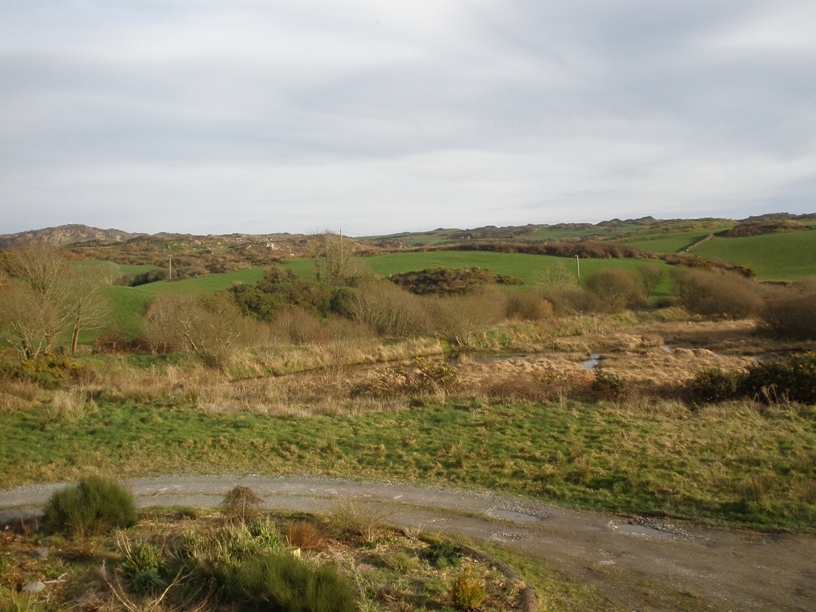
The view from my house: not science fiction enough.

As a companion piece to the step by step that I posted about my Wounded City Zuzzy mat, I figured that I would put up a few shots of the process that I went through with for my Scourged Forest mat.

For many years I have usually had some way to represent green areas in games to hand, but I have had an aversion to using them for a couple of reasons.  As I tend to play sci-fi games almost exclusively I dont really want to play games in settings that look like the view from a window of my house: its just not exotic enough.

Green grassy hills somehow feels a bit too cheap, too much like a low budget episode of Doctor Who.  It is somehow inappropriate when my brightly coloured space ranger is seen wandering around shooting his blasters at giant lizard-bugs over grassy dales and hills.  Maybe if I lived in Nevada or somewhere then grassy hills would seem exotic to me, but I dont so it doesnt.  So I have tended to avoid the eighteenth hole look for my gaming tables.

Having dealt with my urban table needs with the Wounded City mat, the other mat that I required was one suitable for alien landscapes and post apocalyptic deserts: something that would fit in well with my ongoing Standard Falls and Planet Heck scenery projects.

Zuzzy dont yet have a desert mat available (although I have heard that there is one in production).  They do have a Sulfur Fields mat available which represents cooled lava flows and the like but something about that mat just doesnt grab me.  I am not sure if it is the paint job in the site photos or the paint jobs that I have seen gamers give it online, but for whatever reason it doesnt conjur up the sort of wasteland image that I want.

So I didnt buy that one and I bought the Scourged Forest instead.

I doesnt really look like much here.

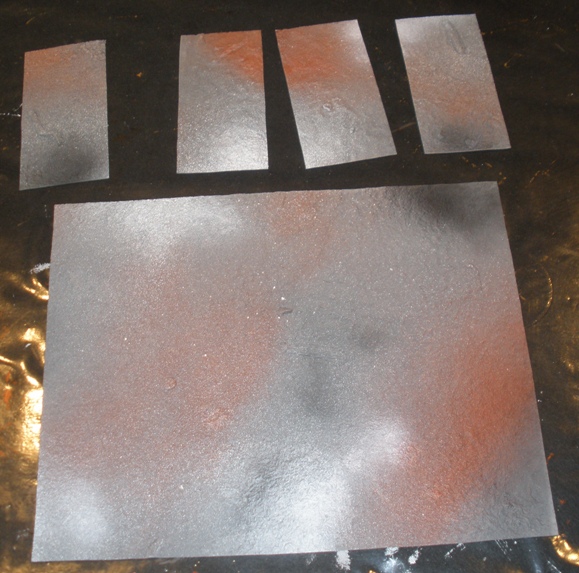
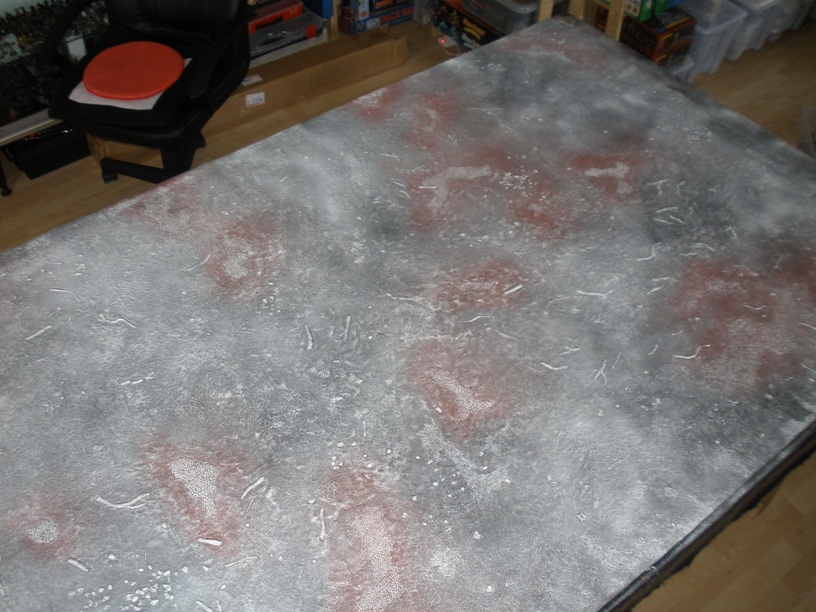
Firstly I took the sample mats that I had and sprayed them with white, black and red oxide primer spray cans.  I hoped that the variation in visual texture that these give would show through the layers and washes above them once finished.

As all of these areas would be covered in layers of paint later there wasnt really any point in being too subtle, so adding lighter (white) and darker (black) tones was an obvious choice.  The red is a less obvious choice, but as some of the other terrain features that I have use the red oxide colour I figured that it wouldnt be any harm to potentially tie them to the mat in any case.

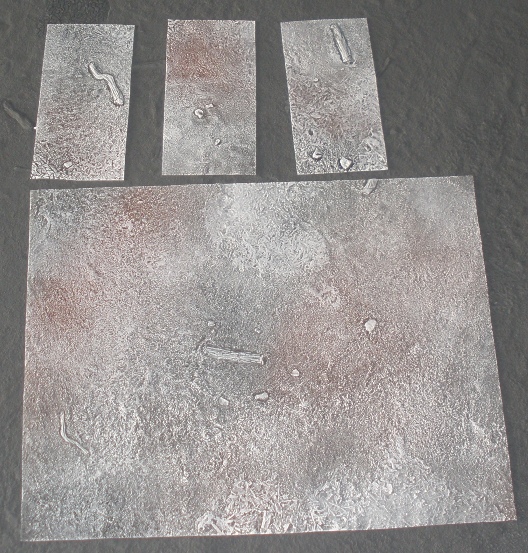
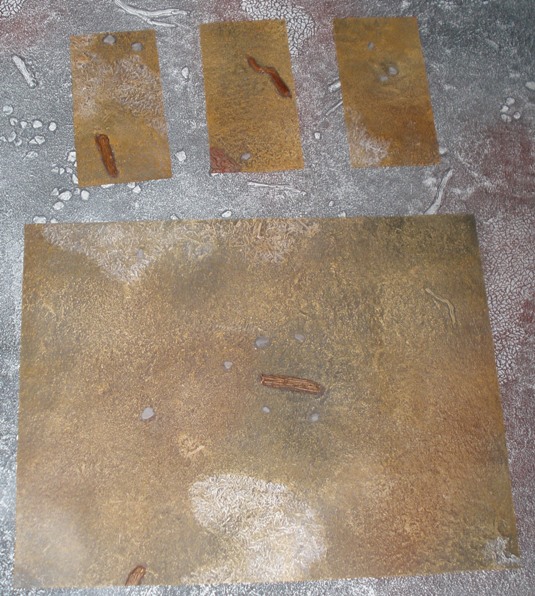
Next I used a paint roller to apply white wall emulsion paint to the test pieces.  I did this because I knew that the Raw Sienna paint that I use for my desert terrain bases isnt terribly opaque, so it would need the white to give it some lift.  Also several thin layers of colour help to make bits like this a bit more believable, so the white layer would help with adding a gradient to the Raw Sienna application.

I made sure that the roller wasnt clogged with paint, the opposite in fact.  I was going for an overbrush/drybrush sort of effect so I removed a lot of the paint from the roller before application.

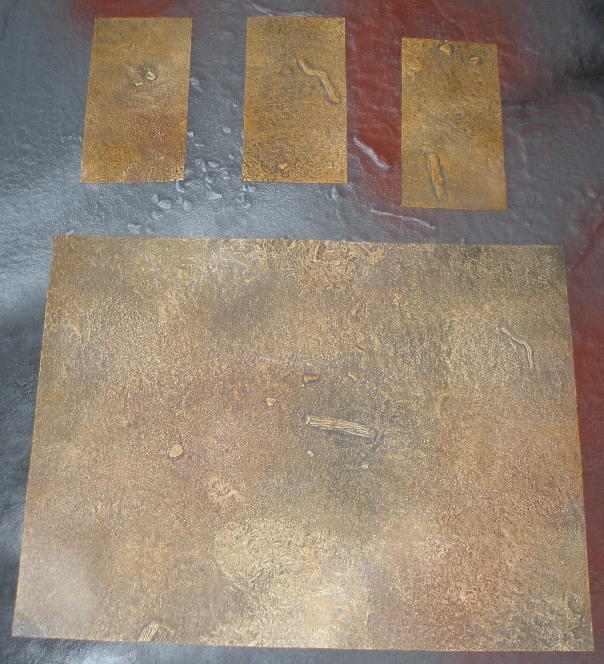
Once the white had dried I rolled the sample pieces with Raw Sienna.  At this stage I was pleased that the various colours sprayed on earlier were still showing through.  As the samples (and the mat itself) were going to be getting a dark wash as one of the final stages it was impossible to know if the areas originally spray painted would still be visible in the end.

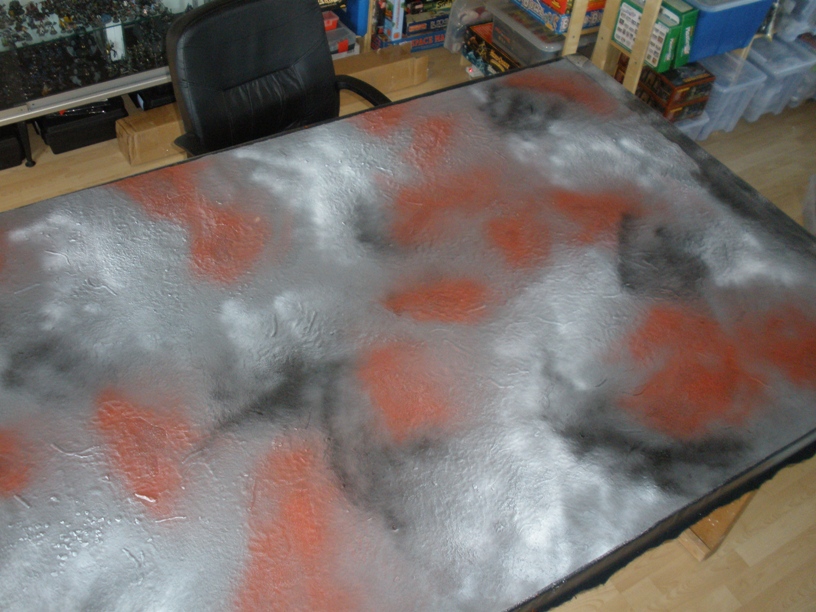
My impatience to get started on the main mat got the better of me after seeing the samples at this stage, so I brought the main mat outside onto a blanket and sprayed it with the colours used earlier.  I focused the red spray on some specific areas sculpted onto the mat and I sprayed the white and black anywhere that I felt like spraying them.

While I waited for the spray paint to dry a bit I plonked a couple of my scenery pieces on the sample mat, just for a look.

I have used cork tiles to make and to base a number of my scenery pieces for a few reasons (cheap, easy to work, interestingly textured etc).  The rocky piece on the left in the photo above is bits of cork tile glued together in layers and then roughly painted with grey, black and a bit of Raw Sienna.

The base of the shack on the right is also made from cork but in this case it was sprayed black as I painted the shack.  In retrospect I should have brushed the edges of the shacks base with white before I applied the Raw Sienna, as it doesnt match the other pieces very well.  So I added a little bit of scenery base blending to the to-do list.

Once the spray paint was dry I rolled the main mat with white emulsion, just like I did with the sample earlier.

While I was waiting for the white on the main mat to dry I started to experiment on the detail on the samples, to see what colours I wanted to use for those.

The brown on the wood was a mistake, it made them look like small cat turds.

The grey on the rocks was ok, but possibly it stands out from the supposedly dusty ground a little too much.

I tested a reddish brown paint on the dried up pond looking elements but I didnt like the result.  There are many of these areas on the map (but very few on the samples unfortunately) so I decided to to underplay them rather than have them stand out too much.

The scrub areas look a little like exposed chipboard, but I hoped that a drybrush of off white will make them look ok, once the washing stages are done.

I enjoy using washes in my miniature painting and terrain making, but it can be a bit nerve wracking, particularly on a large, expensive, irreparable piece like this.  Its impossible to be sure that it will all work out until late in the process.

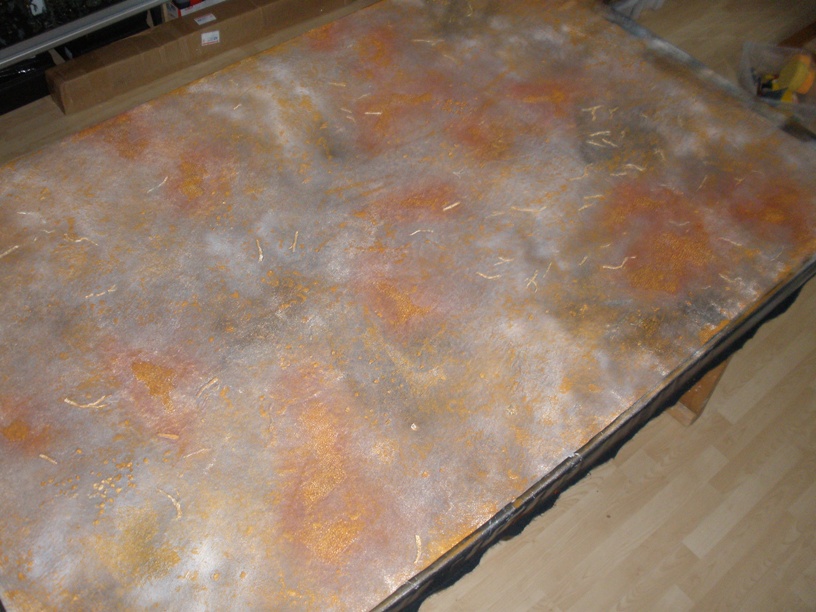
Now that the white on the mat had dried the next step was to roll on some Raw Sienna.  As I didnt want to apply the paint in very thick layers I did this in a number of stages, the first one being shown above.

Also of note is that while rolling the paint on I then wiped the Raw Sienna off each of the logs and bits of dead tree on the map, exposing some of the white underneath.  I hope that this would with give a look reminiscent of the sort of dead tree stumps and logs that tend to be seen with vultures and steer skulls in Westerns.

This is what the mat looked like after a second thin rolling of Raw Sienna.

At this point the batteries in the camera ran out, so the record gets a bit patchy. So you will have to take my word for it regarding what happened next.

I gave the mat a third, very light rolling of Raw Sienna to cover up any areas where a little too much of the original mat colour was visible.  As the mat was going to be covered in a wash of thinned Raw Sienna/black mix which would seep into the recesses, it was important not to get too carried away trying to get full coverage on the mat.

The individual rocks were painted in a mix of grey and Raw Sienna.  I added the base colour used for the mat to the mix too ensure that while the stones stood out, that they still looked like bits of the landscape rather than bits of gravel perched on top of it.

I lightly drybrushed the scrub areas with an off white colour.  I hoped that after the wash those areas would look vaguely like dried grass.

The broken tree trunks were also given a light drybrush of a light brownish white, sort of a bone colour, so that they would also look like dead plants once the wash had dried.

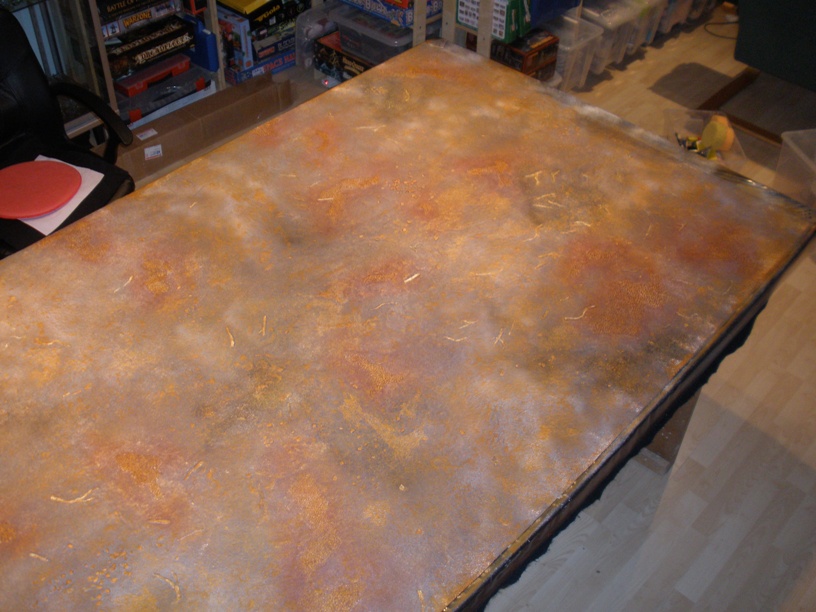
Finally I mixed Raw Sienna and black with water into a milky consistency and brushed it over the entire board.  I tried to get it into the recesses of the mat without letting it pool too heavily.  Then I left the mat to dry and went to bed.

The following morning the wash had dried.  It had given definition and shadow to all of the more three dimensional elements (around the rocks, in between the cracks in the dried mud areas, into the grain of the dead wood) while also softening the contrasts between the various colour layers.  I am very happy with how it turned out.  After quickly adding some of the colour mixes used to the edges of my existing terrain I was finished.

Like the urban mat, I am very happy with the Scourged Forest mat.   I played a game on it last night and it really is a great surface for gaming on.  At the time of writing I cant recommend these mats highly enough.

Comments and criticisms all welcome.

“Wounded City – Broken Blacktop” Zuzzy Gaming Mat

During my gaming “career” I have used a number of different gaming surfaces.

I once had a table that I had glued sand to and painted, but the downsides of a table essentially made of sandpaper became apparent pretty fast, both on miniatures and on my dice-picking-up-knuckles.

I also once had a table that was made to look like it had panels and various other man-made bits and pieces on it that I used for Necromunda games.  It worked ok but but never really gave me the look that I wanted.  The uneven surface was a bit of a pain for placing terrain on too.

The most commonly used boards that I have had were covered in textured wallpaper and a coat or two of paint.  This gave a soft surface that was good for handling miniatures on and it broke up the flatness of plain old painted boards.

I rushed when painting the my most recent wallpaper board and was unhappy with the results.  Therefore having recently reorganised my mancave I decided to take the plunge and prep my gaming surfaces for what I hope will be the last time, so I bought a pair of Zuzzy mats and had them shipped from the US to Ireland.

Of the various different options available for gaming surfaces these seemed to me to be the best choice.  Being able to roll them up for storage is a big deal plus they also provide a surface with some give for when miniatures fall or are lain on their sides.

Zuzzy mats are made from latex and require painting.  They need to be painted mainly with washes and drybrushing as thick layers of paint will crack off the mat when it is rolled for storage.  Below is a step by step of how I went about painting my urban “Wounded City” mat.

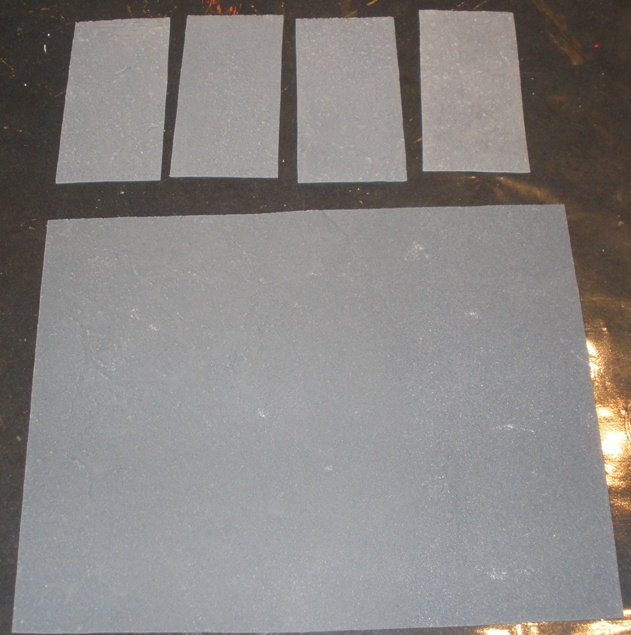
I ordered a number of 6×3″ sample pieces from Zuzzy when ordering the mats, purely to try a couple of painting techniques on.  In addition Zuzzy provided me with a 11×14″ mat for free as an apology for their lengthy shipping times, so I painted that too.


The approach that I took was to drybrush, detail and wash in that order.  The basic colour of the mat is grey so I decide to use that as the base for the asphalt look that I wanted to achieve.  Instead of drybrushing I used a paint roller with limited paint on it, but the principle is the same.

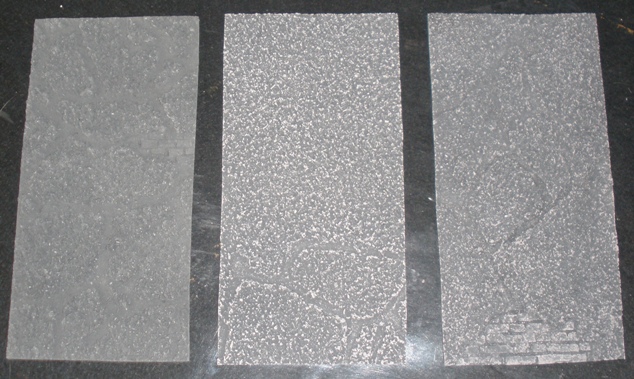
Above is an untouched sample on the left, the second and third pieces have been rolled with a light grey emulsion house paint and the third piece has also had a wash of thinned black emulsion house paint (which is more of a very, very dark grey than pure black really).  I decided that this wash was not strong enough so I added more paint to the wash mix before I tackled the full 6×4″ mat.

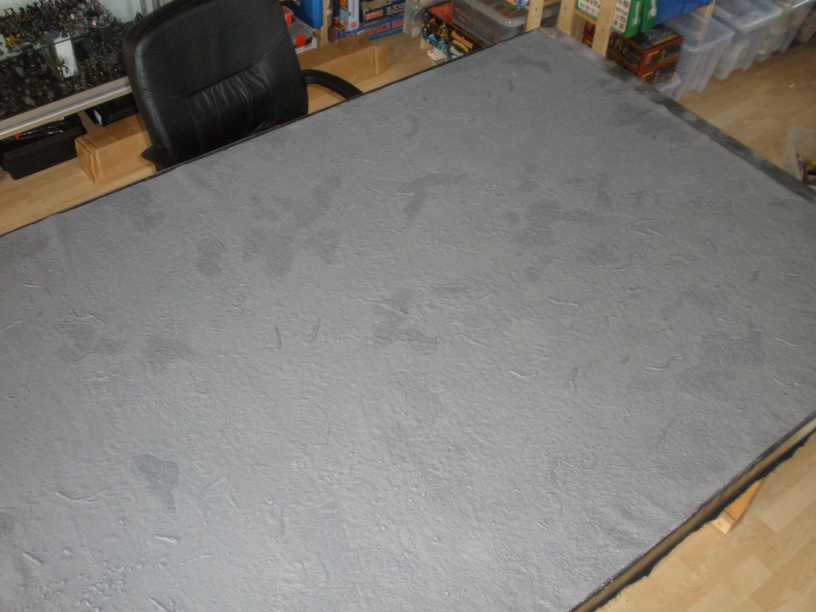
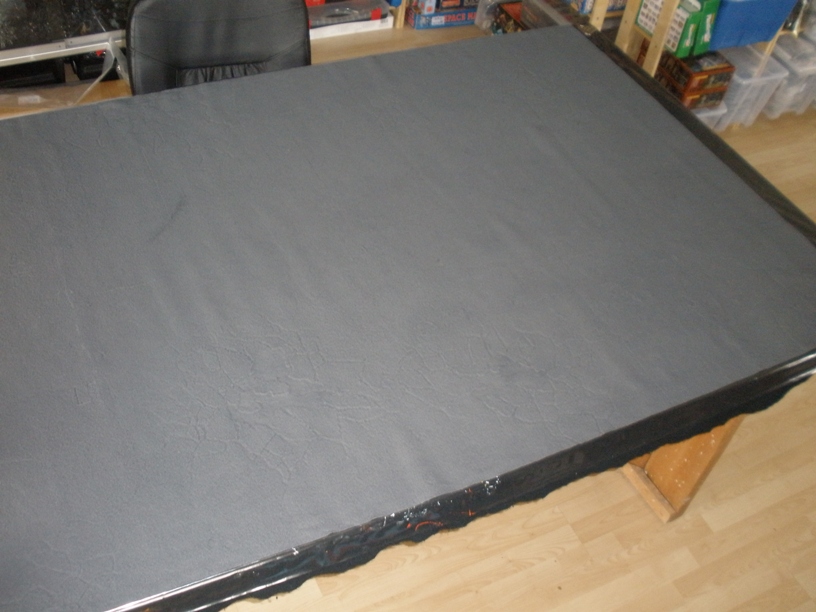
Above is the unpainted 6×4 mat.  The wobbles visible in the shot above tend to flatten out once it has been unrolled for a while, but I took this photo just after unrolling it.

The shot above shows how the mat looked after a quick highlight coat of light grey via roller.  Naturally while I desperately tried to avoid leaving a pattern from the roller I managed to drop a few blobs of paint in a couple of areas.  After a fair bit of swearing and a couple of aborted attempts to remove the blobs I decided to come back to them later in the process.

Despite this it was quite fun rolling this coat on.  This mat has a lot of surface detail that is easily picked up with drybrush/roller techniques.  The detail on the mat is quite crisp, much more than I expected it to be really, so it was pleasant to paint when I wasnt clumsily splashing paint everywhere.

Next up was the exposed brickwork under the cracked bits of road.

I know next to nothing about the construction of roads but as far as I know there are not many bricks used under asphalt in this part of the world.  If there are then they are definitely not terracotta coloured.  I decided to paint them as red bricks simply because I thought that it would provide some visual interest to the board.

I used a mix of some craft colours that I had in a wash to tint the brick areas, rather than paint them.  This was so that I didnt build up too much paint on the mat.

The most enjoyable part of the process so far was this stage.  The asphalt represented on the board is of the “wounded” variety, so in addition to exposed subterranean brickwork there are also cracked tarmac areas.  Also visible is the patchwork of tar bits and pieces that are seen on roads covering up various damage and other works done.

I stippled the tar areas with black emulsion straight from the pot. I didnt want to strictly delineate the cracked areas with paint as I thought that it would look too harsh so I painted black emulsion thinned with water into the cracked areas in a semi-random pattern.

I also stippled paint onto some of the blobs from the first stage at this point.  They tended to blend in with the other supposedly damaged and repaired areas pretty well which was a relief.

I also drybrushed a lighter tone of the colour used for the terracotta brickwork wash onto the bricks.

The last stage of this rather quick process was to wash the whole mat with thinned down black emulsion paint.  Apparently it is possible for the mats to warp and distort if they are drowned in water so as a precaution I dabbed up a lot of the excess wash with paper towels as I was applying it.

The wash served two purposes: it helped to define the recesses of the mat in comparison with the highlight areas while also reigning in and slightly unifying the tones used on the whole thing.

After that was done I put a dehumidifier in the room (to speed up the drying process, just in case leaving the mat exposed to watery paint for too long would cause distortion), shut the door and left the mat until the following day.

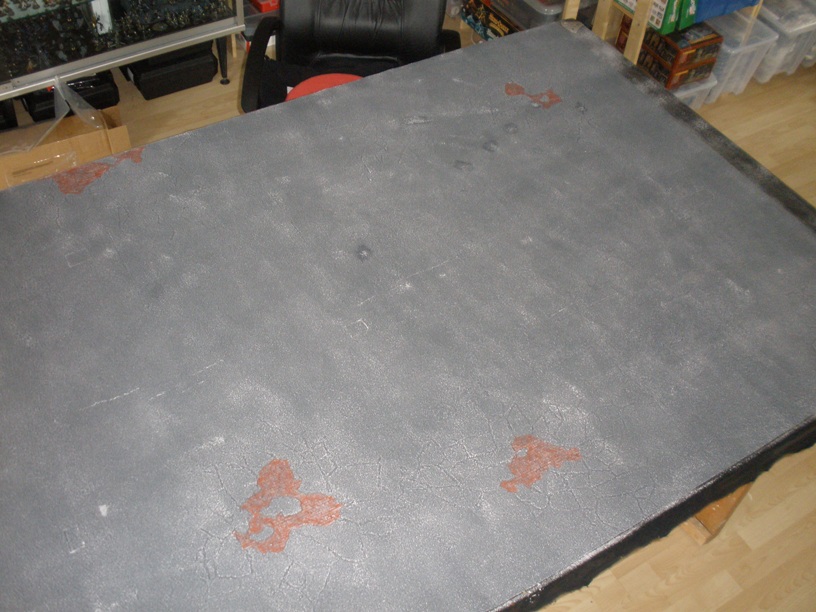
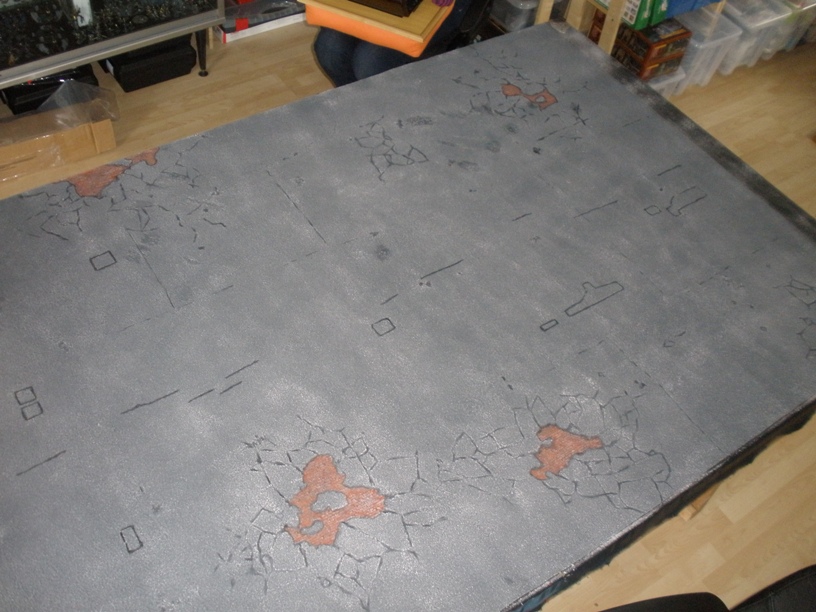
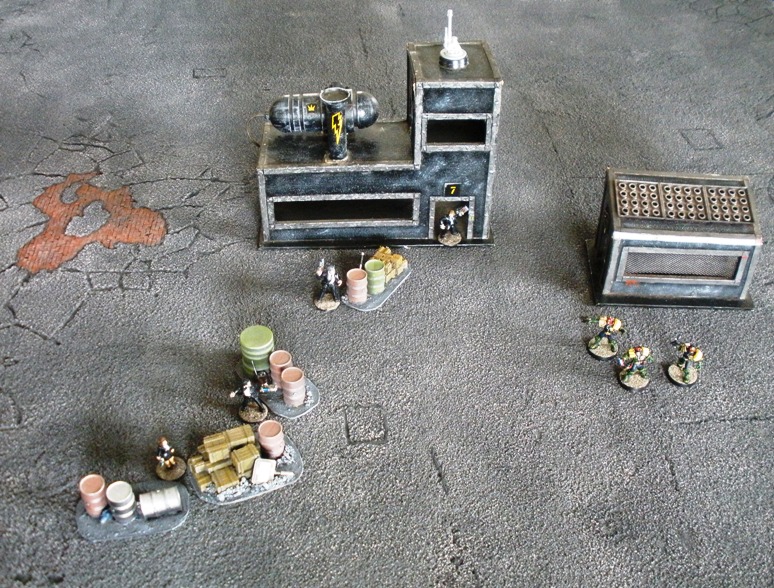
Above is a shot of the finished mat including some now twenty year old terrain.  After literally working from the ground up the next on the urban terrain list is some new buildings…

Despite the ropey old terrain and dodgy lighting in the shot the surface texture is visible.  Its a great surface for gaming on and I am very happy with how it turned out.  It was very fast to do as well it only took easily under two hours to paint, discounting drying time.  Its not that big a project or time investment and it gives a playing surface that really is pretty hard to beat.

I did my wastelands terrain mat next.  I did the urban mat first as I figured that it would be a easier to do and the experience gained from that could  help with the more complex wasteland mat.