Oyumaru/Instant Mold Casting

While prepping some figures for my ongoing Adeptus Mechanicus project I decided to cast up a replacement head for one of the figures.

Way back in the last century I made more silicon rubber moulds than I could count.  I also cast very many items in various resins in them, as it was a large part of my old job working in industrial prototyping.

A lot of people seem to enjoy using those industrial substances at home in their workshops, sheds and hobby rooms and good luck to those people: I hope that they enjoy it.

I on the other hand have no desire to invest time and money in such horrible, toxic and messy substances for use in my house.  Therefore any casting that I do has to be clean, easy and effective.  No vacuum pumps, no multi-part moulds, nothing very complex.  Push moulds and simple two part moulds for tiny items are the limit of my casting desires at the moment.

So I got some “oyumaru” (also known as “Instant Mold”) and used it as outlined below.  I used nothing but basic techniques and I wouldnt really describe it as a “how-to” or anything, but it might be of interest to someone.

Firstly I selected the replacement part that I wanted to cast: its the hooded and masked head shown on the bottom right in the picture above.
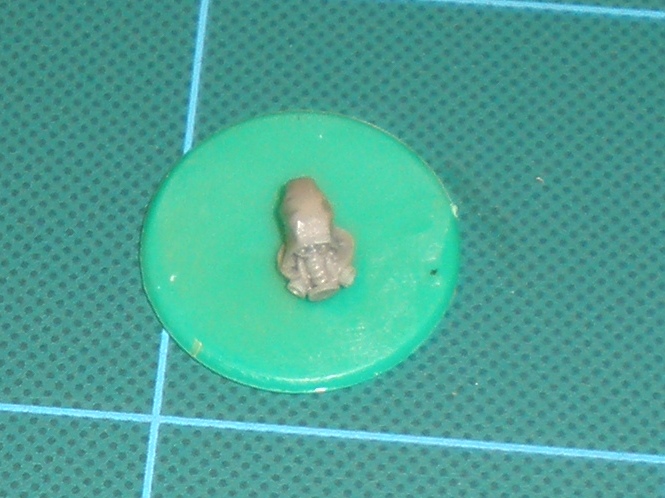
Next I cleaned up mould lines and all of that, filed the underneath of the neck flat and stuck this flat area to a flat piece of plastic (a tiddlywink).

I attached the part to the tiddlywink as I wanted to make sure that I could get the mould rubber to cover the detail on the bottom of the part.  I found it easiest to stick the part to something flat to so that I could work the oyumaru into it while still maintaining a flat base to the mould.  I hoped that this would help to minimise distortion in the castings later while also making the part easier to handle.
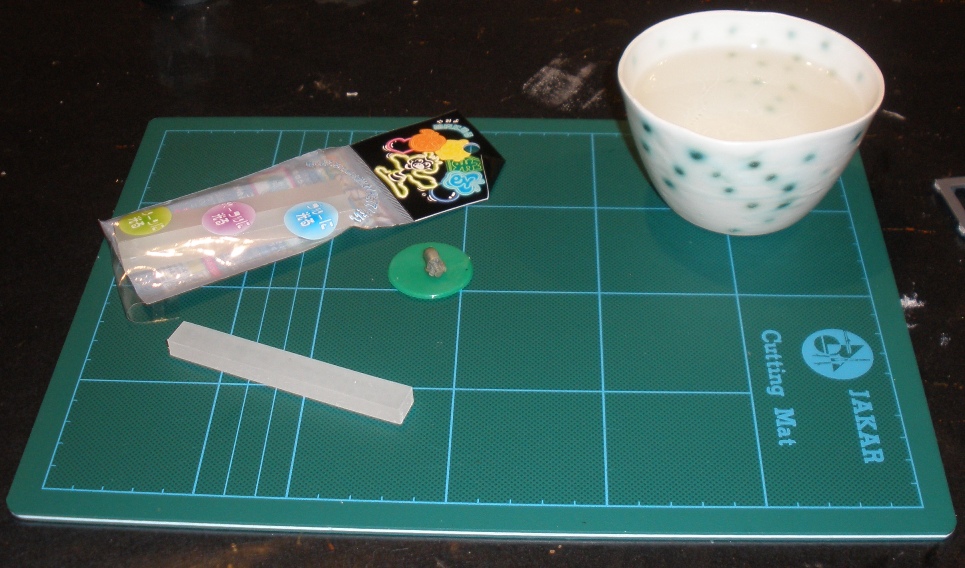
Next I got a small bowl of boiling water and the oyumaru.  The oyumaru is the waxy looking long rectangle on the left.   In its room temperature state it has a similar consistency to a low melt glue stick
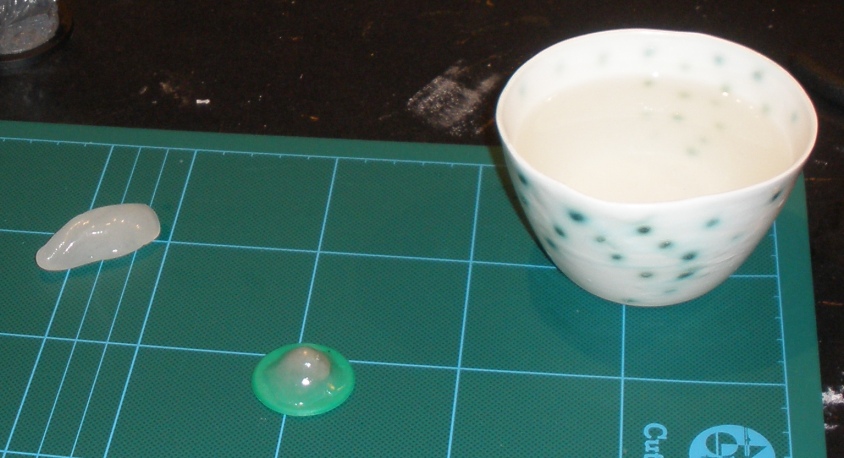
The oyumaru was submerged in the hot water for a minute or two at which point it became very pliant.  I quickly covered the part in oyumaru.  I ensured that I worked the material under the part and and against the flat plastic tiddlywink.  I also tried to minimise possible air bubbles in the detailed face area by working the oyumaru gently into those details as carefully as I could.
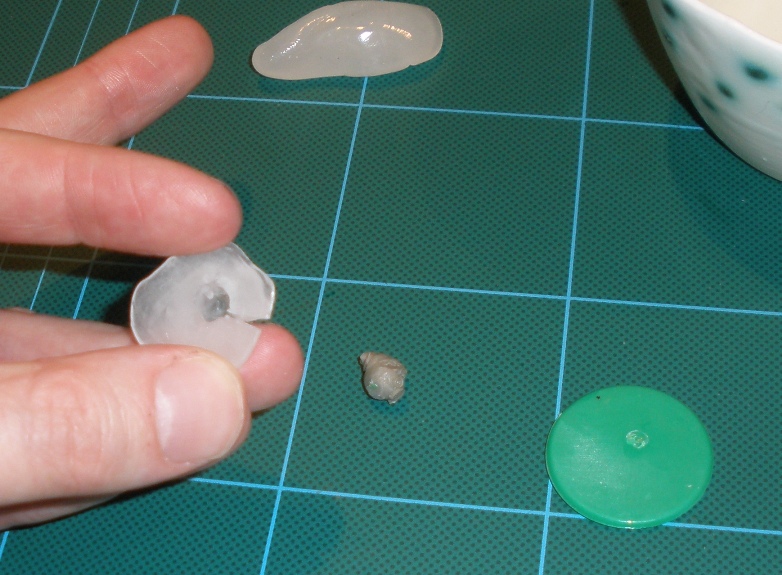
A few minutes later the oyumaru had cooled down and become rigid again.

I prised the part from the tiddlywink.  Then starting at the bottom where the part had been glued to the plastic I used a scalpel to cut through the side of the mould.

I went about two thirds of the way around the mould, gently cutting to the part as I went.  I didnt want to split the mould entirely in two as I didnt want the hassle of having to engineer some way of keying the two halves back together when casting.  Keeping the mould attached would help to minimise that.

Also of note is that I slit the mould from ear to ear across the top of the head, from the parts perspective.  As the head is hooded I figured that those areas would be the easiest to clean flashing and mould lines from later.  Obviously, splitting the mould through highly detailed or recessed areas would make cleaning up the subsequent castings far more difficult (as anyone reading who has ever had to clean a crappy mould line of the side of a miniatures head knows).
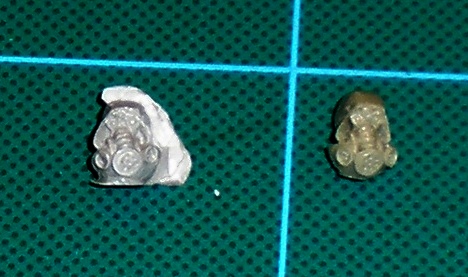
I then mixed up some two part epoxy putty (I used ProCreate, which is essentially grey coloured “Green Stuff”) and pushed that into the mould.

Like when making the mould itself, I was careful to make sure that as much of the detailed face area was filled as possible.  The part as it came out of the mould is on the left.  Note the flashing from the cut side of the mould.  Although it looks bad in the photo it really is only a fraction of a millimeter thick, so it took only a moment to remove.
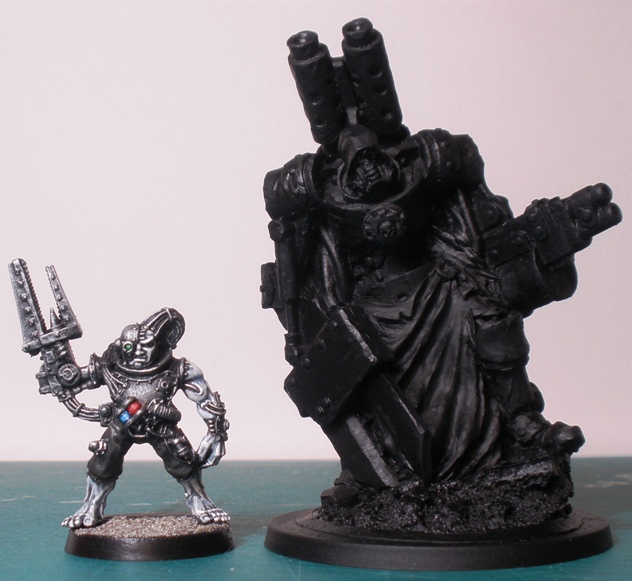
Above is a quick snap of the newly cast head in its new home.  As you can see its a pretty huge figure (from Ramshackle Games) which is why I included the Servitor for comparison.  The size of the target figure isnt really releant anyway, the piece cast was a standard 28mm heroic scale head.

Like that head, the Adeptus Mechanicus cog on the big models chest is also made of ProCreate via an Oyumaru push mould.  That also came out pretty well.

My verdict on this stuff is that its brilliant.  It provides a very simple, low outlay and non-toxic way to replicate miniature parts.  I see this as being part of my hobby toolbox for good.

“Wounded City – Broken Blacktop” Zuzzy Gaming Mat

During my gaming “career” I have used a number of different gaming surfaces.

I once had a table that I had glued sand to and painted, but the downsides of a table essentially made of sandpaper became apparent pretty fast, both on miniatures and on my dice-picking-up-knuckles.

I also once had a table that was made to look like it had panels and various other man-made bits and pieces on it that I used for Necromunda games.  It worked ok but but never really gave me the look that I wanted.  The uneven surface was a bit of a pain for placing terrain on too.

The most commonly used boards that I have had were covered in textured wallpaper and a coat or two of paint.  This gave a soft surface that was good for handling miniatures on and it broke up the flatness of plain old painted boards.

I rushed when painting the my most recent wallpaper board and was unhappy with the results.  Therefore having recently reorganised my mancave I decided to take the plunge and prep my gaming surfaces for what I hope will be the last time, so I bought a pair of Zuzzy mats and had them shipped from the US to Ireland.

Of the various different options available for gaming surfaces these seemed to me to be the best choice.  Being able to roll them up for storage is a big deal plus they also provide a surface with some give for when miniatures fall or are lain on their sides.

Zuzzy mats are made from latex and require painting.  They need to be painted mainly with washes and drybrushing as thick layers of paint will crack off the mat when it is rolled for storage.  Below is a step by step of how I went about painting my urban “Wounded City” mat.

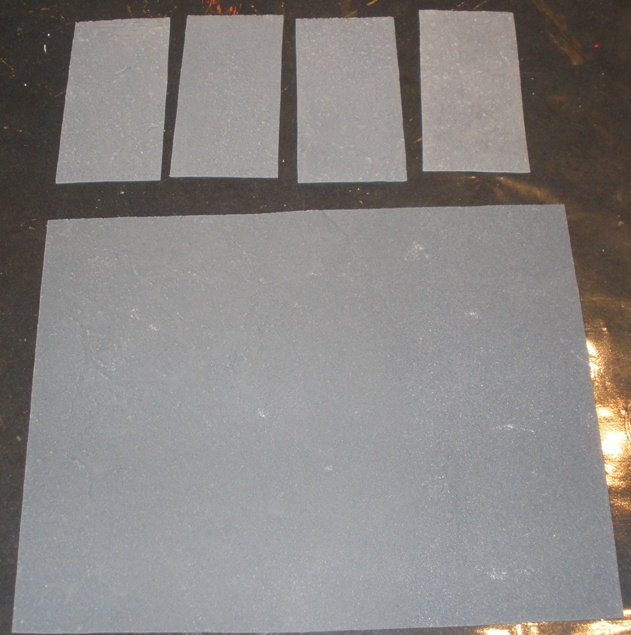
I ordered a number of 6×3″ sample pieces from Zuzzy when ordering the mats, purely to try a couple of painting techniques on.  In addition Zuzzy provided me with a 11×14″ mat for free as an apology for their lengthy shipping times, so I painted that too.


The approach that I took was to drybrush, detail and wash in that order.  The basic colour of the mat is grey so I decide to use that as the base for the asphalt look that I wanted to achieve.  Instead of drybrushing I used a paint roller with limited paint on it, but the principle is the same.

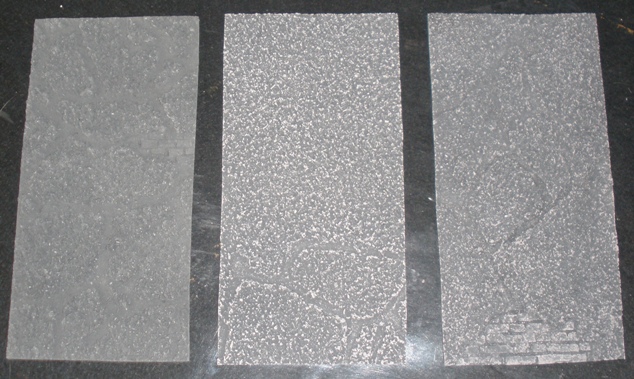
Above is an untouched sample on the left, the second and third pieces have been rolled with a light grey emulsion house paint and the third piece has also had a wash of thinned black emulsion house paint (which is more of a very, very dark grey than pure black really).  I decided that this wash was not strong enough so I added more paint to the wash mix before I tackled the full 6×4″ mat.

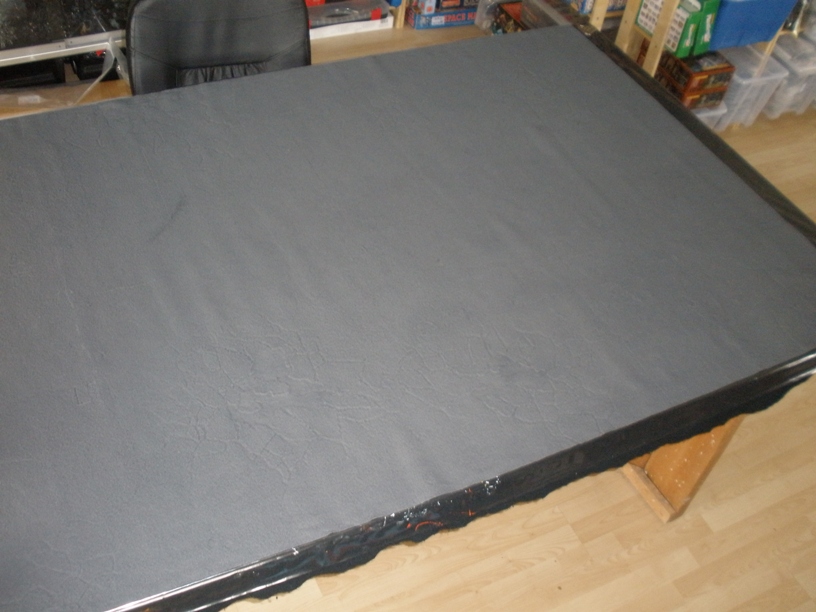
Above is the unpainted 6×4 mat.  The wobbles visible in the shot above tend to flatten out once it has been unrolled for a while, but I took this photo just after unrolling it.

The shot above shows how the mat looked after a quick highlight coat of light grey via roller.  Naturally while I desperately tried to avoid leaving a pattern from the roller I managed to drop a few blobs of paint in a couple of areas.  After a fair bit of swearing and a couple of aborted attempts to remove the blobs I decided to come back to them later in the process.

Despite this it was quite fun rolling this coat on.  This mat has a lot of surface detail that is easily picked up with drybrush/roller techniques.  The detail on the mat is quite crisp, much more than I expected it to be really, so it was pleasant to paint when I wasnt clumsily splashing paint everywhere.

Next up was the exposed brickwork under the cracked bits of road.

I know next to nothing about the construction of roads but as far as I know there are not many bricks used under asphalt in this part of the world.  If there are then they are definitely not terracotta coloured.  I decided to paint them as red bricks simply because I thought that it would provide some visual interest to the board.

I used a mix of some craft colours that I had in a wash to tint the brick areas, rather than paint them.  This was so that I didnt build up too much paint on the mat.

The most enjoyable part of the process so far was this stage.  The asphalt represented on the board is of the “wounded” variety, so in addition to exposed subterranean brickwork there are also cracked tarmac areas.  Also visible is the patchwork of tar bits and pieces that are seen on roads covering up various damage and other works done.

I stippled the tar areas with black emulsion straight from the pot. I didnt want to strictly delineate the cracked areas with paint as I thought that it would look too harsh so I painted black emulsion thinned with water into the cracked areas in a semi-random pattern.

I also stippled paint onto some of the blobs from the first stage at this point.  They tended to blend in with the other supposedly damaged and repaired areas pretty well which was a relief.

I also drybrushed a lighter tone of the colour used for the terracotta brickwork wash onto the bricks.

The last stage of this rather quick process was to wash the whole mat with thinned down black emulsion paint.  Apparently it is possible for the mats to warp and distort if they are drowned in water so as a precaution I dabbed up a lot of the excess wash with paper towels as I was applying it.

The wash served two purposes: it helped to define the recesses of the mat in comparison with the highlight areas while also reigning in and slightly unifying the tones used on the whole thing.

After that was done I put a dehumidifier in the room (to speed up the drying process, just in case leaving the mat exposed to watery paint for too long would cause distortion), shut the door and left the mat until the following day.

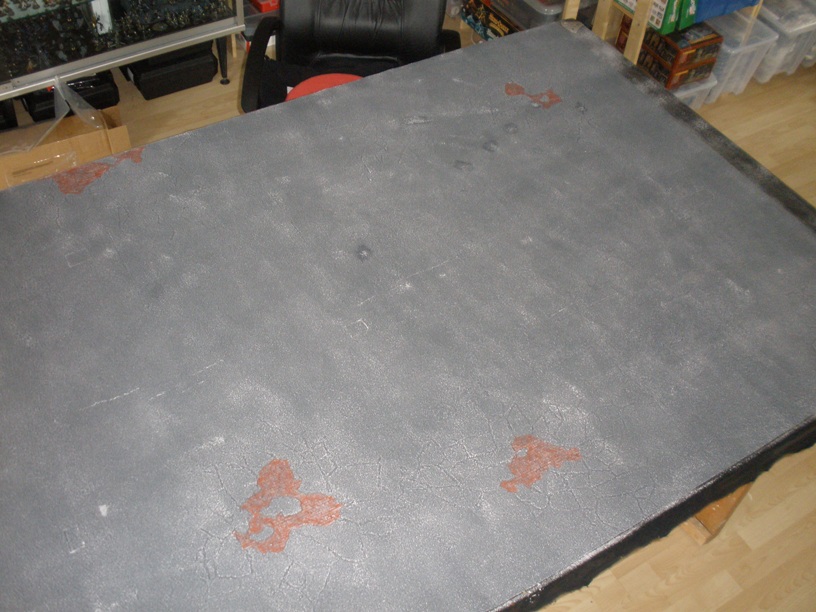
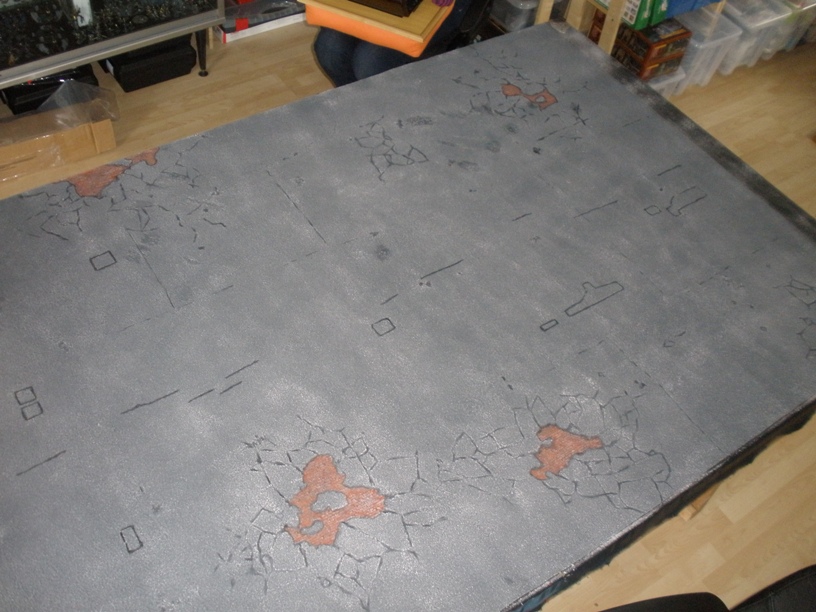
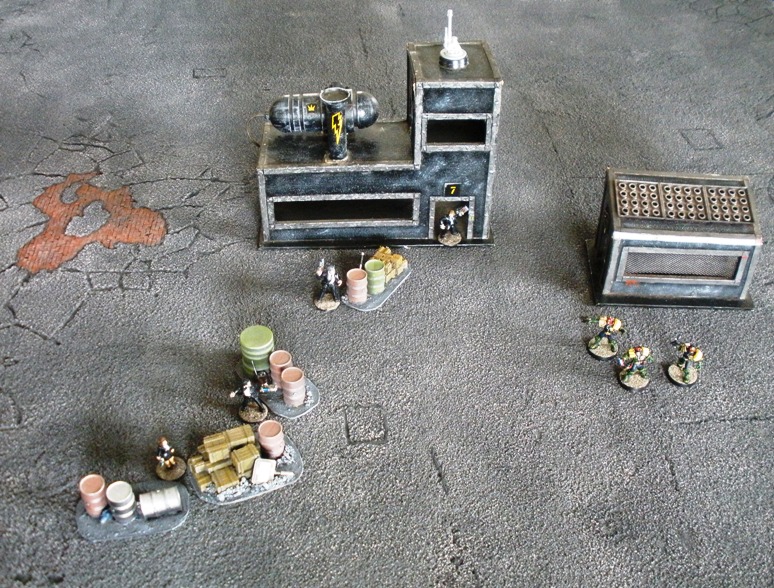
Above is a shot of the finished mat including some now twenty year old terrain.  After literally working from the ground up the next on the urban terrain list is some new buildings…

Despite the ropey old terrain and dodgy lighting in the shot the surface texture is visible.  Its a great surface for gaming on and I am very happy with how it turned out.  It was very fast to do as well it only took easily under two hours to paint, discounting drying time.  Its not that big a project or time investment and it gives a playing surface that really is pretty hard to beat.

I did my wastelands terrain mat next.  I did the urban mat first as I figured that it would be a easier to do and the experience gained from that could  help with the more complex wasteland mat.